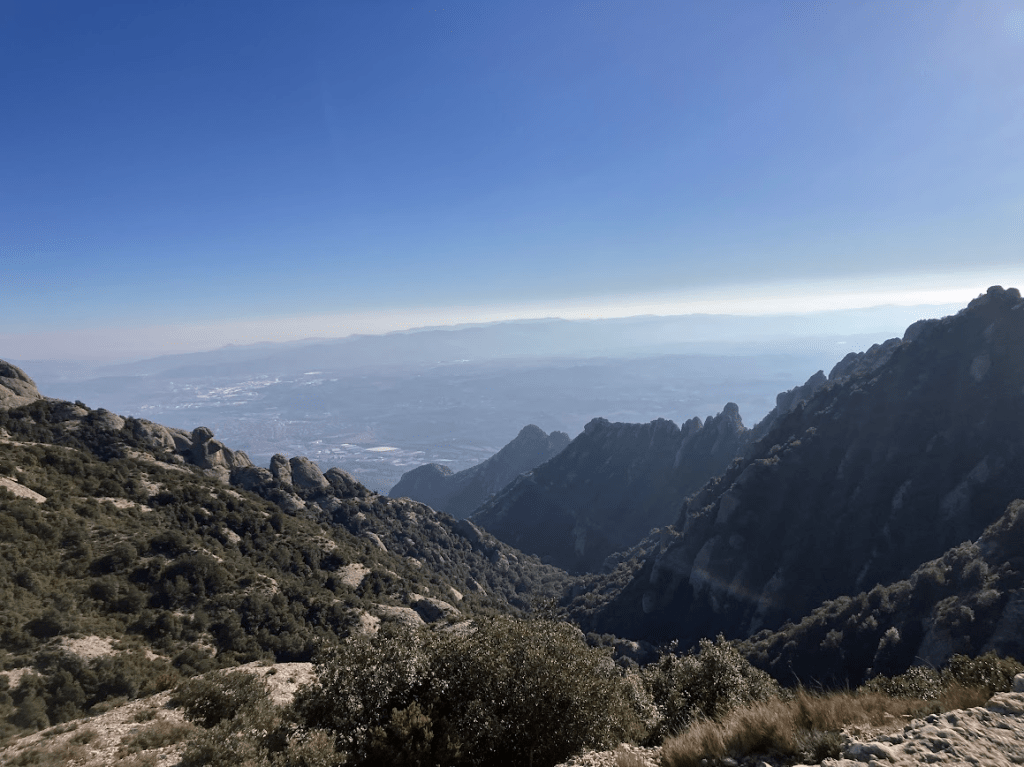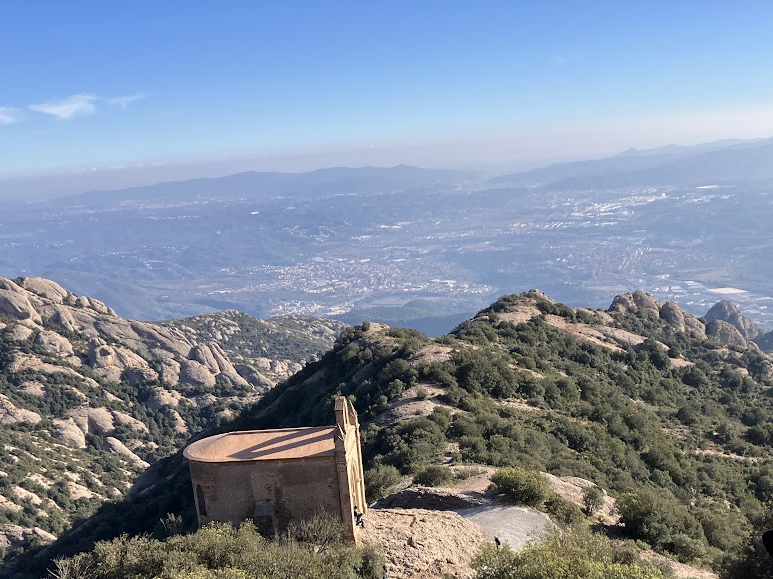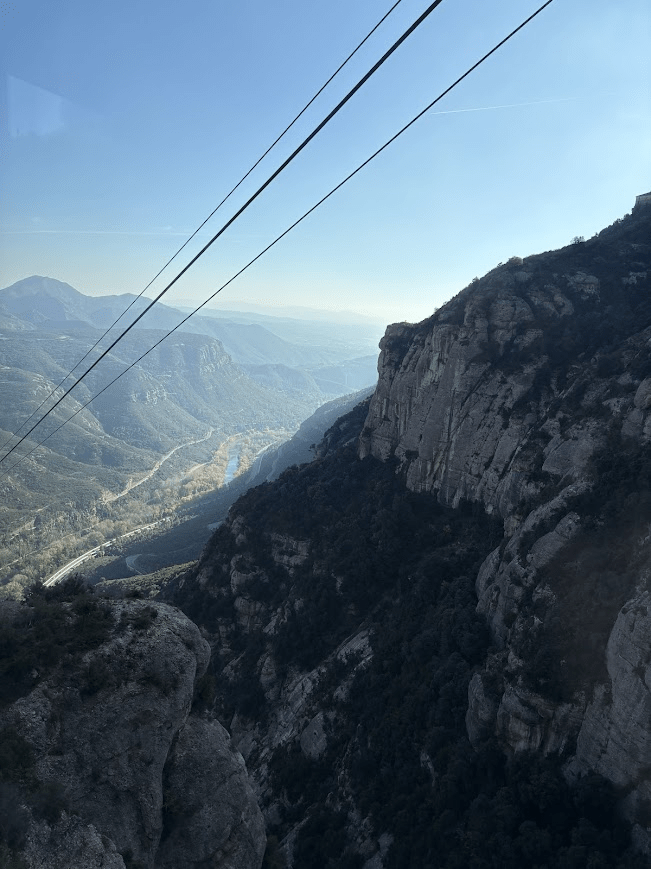
There are tons of different ways to explore Montserrat, with dozens of tour companies taking advantage of tourists to offer big “excursions” for big money. I’m sure many of these are wonderful for those who want to do tapas, and wineries, and distilleries, and big coach buses, but for me and my wife, we just wanted to view the basilica – and hike.
If I could do it again, I would have started at the first transport up the mountain, as my only grievance was that we didn’t have enough time to explore all that we wanted to see. We did pieces of a few trails, but didn’t have the time for the longer hikes.
Getting there:
Because we wanted the maximum amount of free time to explore and hike around, we opted out of one of those company excursions with all-inclusive activities and instead purchased the “Trans Montserrat Ticket” from Turisme de Barcelona Information Office at Plaça de Catalunya. It’s not something you can buy online and just show on your phone; you have to go in person. You can buy them in advance if you know when you’re going; we simply purchased the day-of; however, if we had known for sure in advance which day we planned to travel to Montserrat, we would have purchased and picked up our card in advance to save some time day-of. There is also a “TOT Montserrat card” which includes everything we purchased, plus a buffet lunch.
round-trip train fare (you don’t have to pick the time in advance). The train is basically a commuter rail, not a high-speed train, so be prepared to make plenty of stops.
round-trip train or cable car to Montserrat. You must choose at the time of purchase between the rack railway car or the cable car*
unlimited rides on the funiculars. There are 2 funiculars, which grant you convenient access to the multiple levels of the mountain. We took the one to the very top to hike!
Access to the cathedral and audiovisual space.
*We did the cable car, and I’m glad we did – the views were incredible and it was honestly pretty awesome. Some things to note though: 1) for those claustrophobic, they really pack you in like sardines; 2) I would not recommend for folks scared of heights; 3) the journey is quick, but know that it’s standing room only for those with limited accessibility; and, 4) even in the off-season – early December – on a weekday, the line was long. We waited probably 15-20 minutes to board our car. There are only 2 cars that continuously loop, so were I to do this in peak season, I’d probably opt towards the rack rail to avoid waiting in a 45-minute+ line.
Day Six: Game of Thrones?
It happened again. Sickness strikes abroad.
We had another slow morning with a light breakfast and sudafed before taking the high-speed rail to Girona.
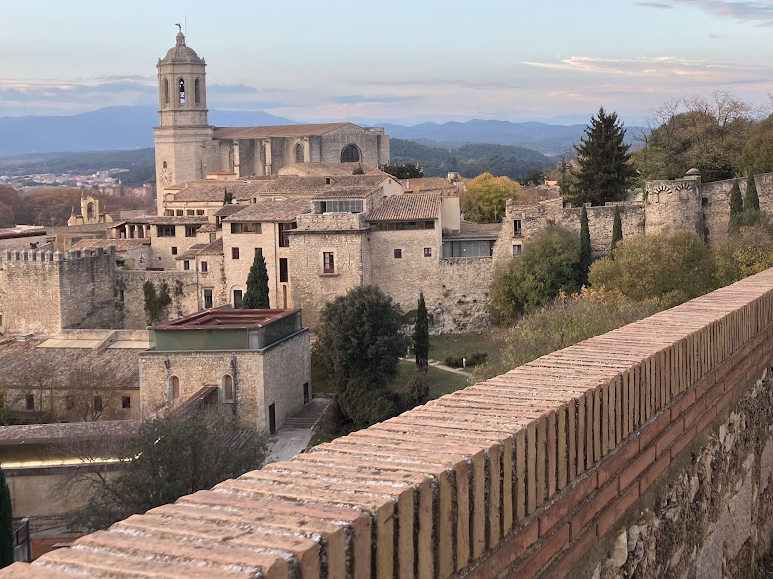
The train was about 40 minutes. We grabbed a snack of an incredible, loaded salmon toast from a bar on a square and then followed a guide through the old town. The bartender was very friendly and patient; she really appreciated our efforts to try speaking Spanish. The absolute coolest part was the city walls that originally enclosed the town (now, of course, the town spreads within and beyond the walls). The walls and towers are open access, and offer incredible views of the city.
Several scenes from Game of Thrones were filmed here as well, and those interested can pay for Game of Thrones walking tours to show you all of the spots. We did our tour self-guided, but still made the effort to visit those locations from the show.
_______________________________________
Lez-Travel Rating:
This is a bit trickier to rate since we didn’t have much interaction with others. I’d be inclined to be distrustful of Montserrat, with it’s Catholic affiliation. Girona, a smaller town, seemed fine – while we didn’t notice any significance of gay pride showing, we felt safe.
Typically, in flights from Columbus, OH, we connect in Philadelphia when traveling to Europe. It’s a drab place (I know, I have spent a whole night here before – thanks U.S. Airways), but an American Airlines hub. My wife travels for work and has earned a depressingly high level of status and perks with American.
This trip, I picked up some travel books from the library. I haven’t done this before, but always will from now on – they have the newish publications, it’s zero dollars, and why buy a travel book for just six days when you’re going to be stuck with it? Even if we return to Barcelona (I hope we do! It was awesome!), we would need the newer version. It also allowed us to compare notes.
I’m getting ahead of myself. So, my wife’s perks landed us to the fanciest of fancy American lounges, our ticket earned in combination with our international tickets and my wife’s ultra-status. They greet us with a glass of champagne, which we carry amidst giggles to a bartop area by the windows. Not only do they have an open bar and full buffet, but also meals to order – all for free. Never has a six-hour layover been more fun.
My wife tackled the Lonely Planet and I picked up the Fodor’s, and we started planning our trip – which we hadn’t done at all – besides booking tickets to la Sagrada Familia. After six hours of snacking, drinking, and planning, we made our way towards our red-eye flight, landing in Barcelona around 8:00am. We hailed a cab from the airport (very reasonable fare, particularly as uber and lyft are rare–and frowned upon) to our hotel.
By a stroke of luck (and aforementioned wife’s status), we were able to check in at 9am. We headed to our room, freshened up, and then broke all the rules on adjusting to the time change. The second my head hit the pillow, feeling how incredibly and impossibly comfortable I felt, I said “uh oh” and fell immediately into a deep sleep.
Our alarms went off 2 minutes later (hours, it was 2 hours), but our struggles to get up and ready caused us to miss our city walking tour. We had booked through one of the “free” companies, so we notified them and then planned our afternoon using our handy library guidebooks.
We chose a self-guided tour around the gothic area, Barcelona’s old town. We purchased a 10-ride transit pass (no expiration) which worked well for us, since some days, we didn’t use transit at all, and used buses almost as often as the metro. We landed at Plaça de Catalunya and wandered around for a bit (it was heavily under construction) before moving into the Gothic area.
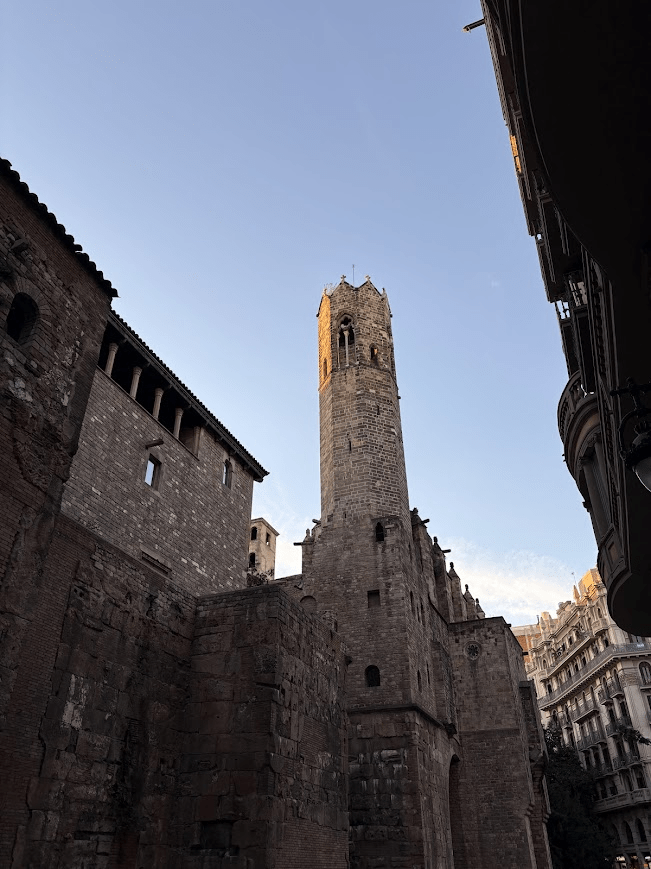
Had we been more prepared, we would have downloaded Rick Steves’ free audioguide for this neighborhood, but we followed his route in any case. We explored the area around the Catedral de Barcelona (we didn’t pay for entry), but enjoyed walking around the area and enjoying some of the history as shared by Rick Steves. There are free hours to enter the Cathedral, but – we hadn’t timed it just right. No matter – it was a gorgeous day and plenty enjoyable to view all of the narrows streets, plazas, and gothic architecture.
We stopped at Bar del Pla, one of the few places that’s open during the pre-dinner time (most restaurants do not open for dinner until 7:30 or 8pm). It was crowded, but they made space for us after first trying to seat us by the toilets. We ordered wine (I believe I got the house red, which was low-cost and delicious) a few tapas – tomato bread, croquettes, and our first of many experiences with jamon iberico.
After our pre-dinner snacks/ late lunch, we continued walking the neighborhood where each “street” is a tiny alley that all wind around like a maze. We eventually find what we’re looking for — the Basílica de Santa Maria del Mar. We expected to have to pay (listed as five euro), but the entry for us was free.
Our selected destination for dinner didn’t open until 8pm, so we popped in to a cocktail bar on the same plaza: Cocktail Bar Mudanzas. The drinks were unique, colorful, and incredibly strong!
For dinner, we showed up just after 8pm, mere minutes after the restaurant opened, and it was already slammed: Cal Pep. The staff squeezed us in at the bartop. The restaurant has no menu, just a chalkboard list of the daily offerings, listed in Spanish. The server went very quickly through the options, and we agreed to too many things, not always knowing what we were signing up for – but it was all incredible.
Day Two: the Scam
I admit it. We were scammed (kinda).
I’m ashamed.
While on our way home from a camping trip, our cousins who had just traveled to Barcelona messaged us saying, “OMG! You haven’t bought tickets for Sagrada Família yet?! You need to — NOW.” For the record, folks visiting in the off-season are probably just fine by purchasing tickets a few days or week in advance, but our cousins had traveled to Barcelona in July.
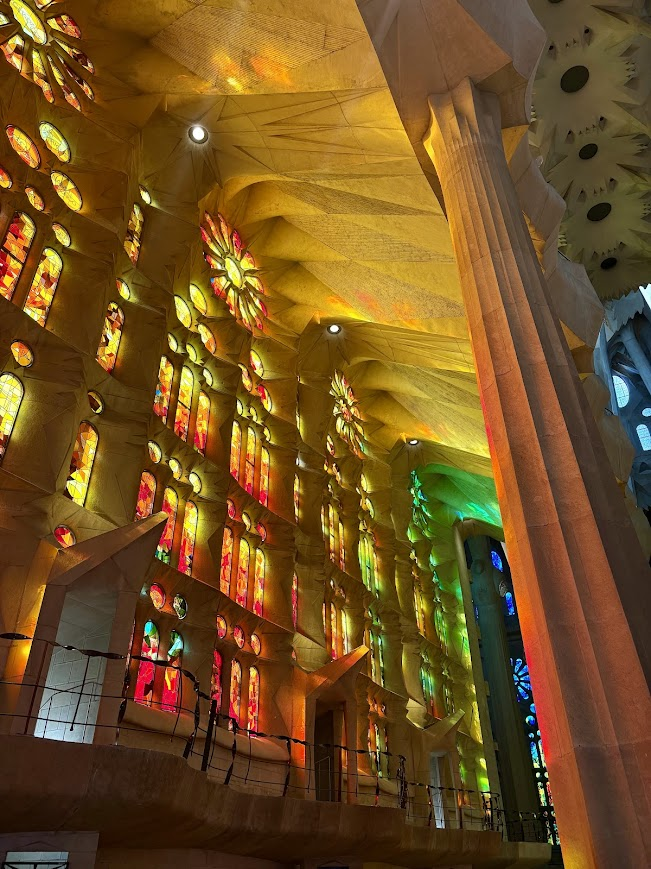
So, with our cell phones as our only devices, we quickly purchased tickets without doing due diligence. When we arrived at the basilica (note: they turned people away for arriving late, so you must arrive during your ticket window), we used our scammy tickets to enter (second note: the security of the basilica is more thorough than Spanish Border Control).
Once inside, we realized our tickets were sold third-party and the audio guide would not download on the free Sagrada Família Wi-Fi. We approached staff to request the visitor audio guides, but since our tickets were purchased third party (for double the price), we were not able to utilize the basilica’s audio guide.
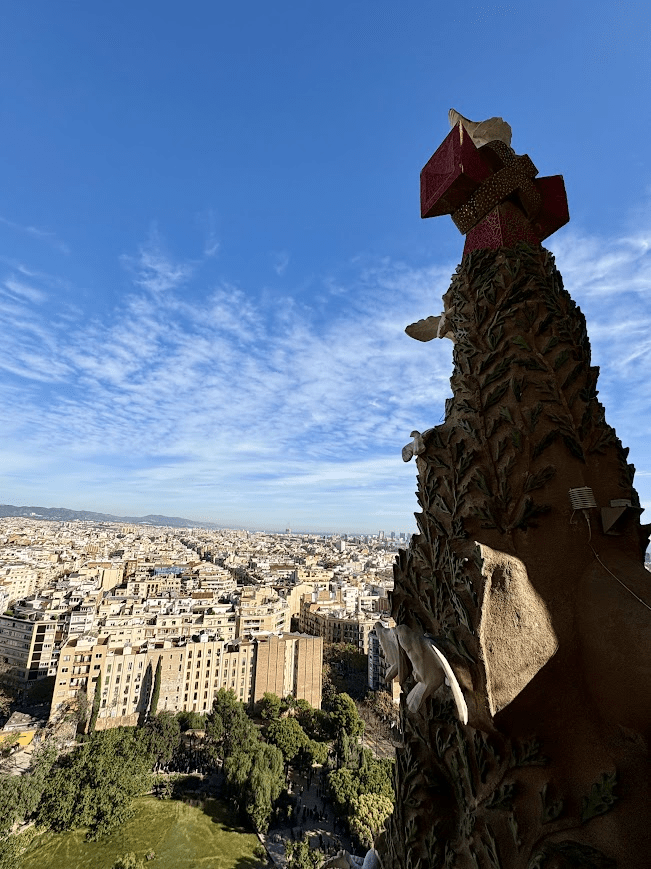
So – we still were able to enter, explore one of the towers, and view the masterpiece that is Sagrada Família, but not having access to an audio guide was a huge bummer. I take responsibility for this screw-up; we’re typically way more careful and have always noticed the websites that pay google to show up first in the search, mimicking and impersonating the legit websites — but still, beware the third-party sellers out there, that sell tickets to the basilica for twice or ten times the cost that the Sagrada Família actually charges, and with fewer resources and access. They make their website look as close to identical as the real thing as possible and purchase a domain as close as possible, like, SagradaFamília.org. If we hadn’t been in a rush, I’m confident we would have realized our error. And – at least we got to see it!
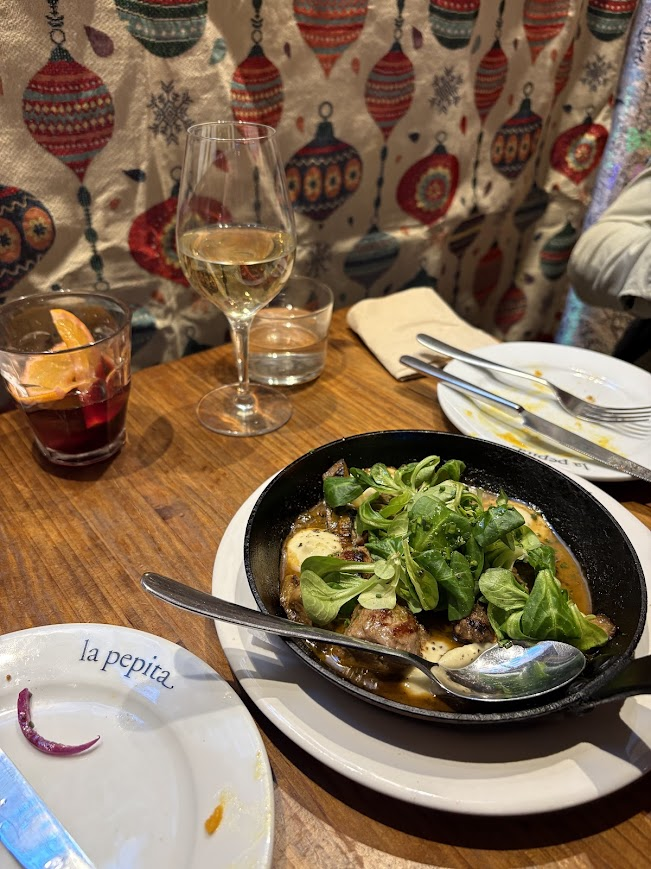
After the Sagrada Família, we wandered through the plaza (Plaça de la Sagrada Família) for a final, different view of the basilica. We popped into a bar that had just opened for a quick beer and bathroom break while we used the bar’s Wi-Fi to check out some options for a late lunch. We decided to get a bit away from the touristy area and walked about a mile to La Pepita. It was a hip bar with excellent tapas.
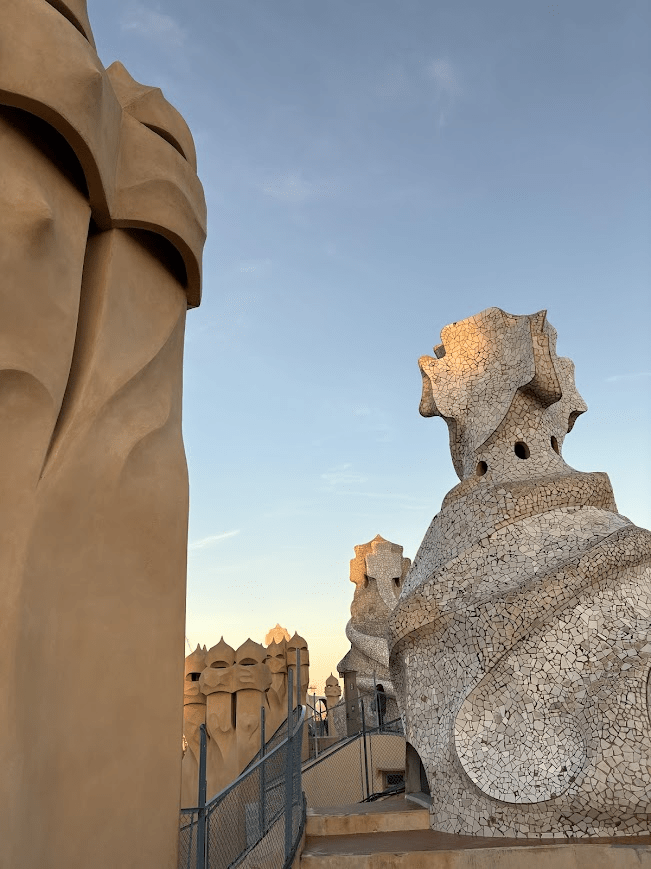
To round out our afternoon, we walked up to Gaudi-designed mansion La Pedrera – Casa Milà. We purchased tickets at the door (note: you can save a few euros per person by purchasing in advance online). The tour includes an audio guide and headset. I would definitely recommend catching the sunset; the views from the roof were incredible.
Following la Pedrera, it was about time for dinner – already 7:30pm, but we were still the first people at the restaurant – a back-alley spot known for its paella. The service was friendly, but the paella was just fine, unfortunately, and the walk to get to the restaurant was, at best, uneasy, especially for two women. Drunk men watched the women’s every movement, and the restaurant was situated along a dark alley with a rank smell and belligerent humans. For those reasons, I’d steer clear of this restaurant. Sketchy alleys aside, this is Barcelona! We can’t stand for mediocre paella!
Day Three: BARCA
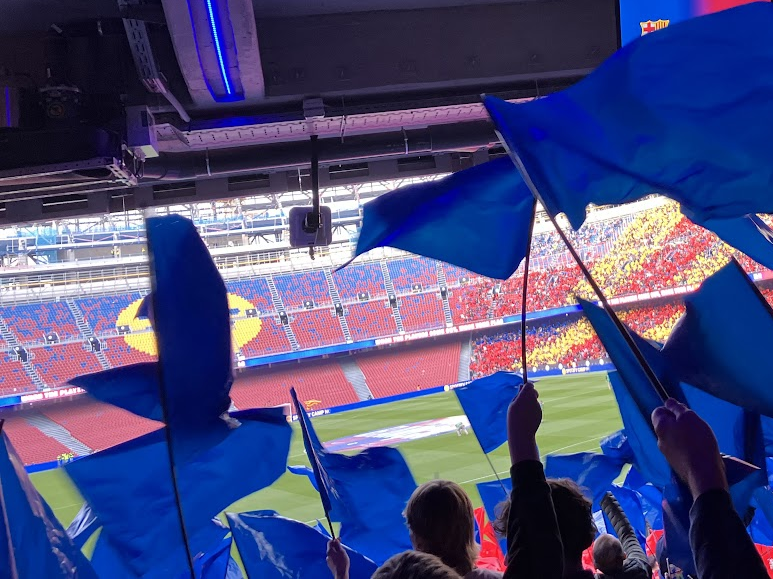
Day 3 welcomed my wife’s biggest dream: Barca futbol match. The match started early afternoon, and we had a slow morning before heading out from the hotel — too slow, really; we had planned to venture through the Jardines de pedralbes, but ran out of time.
Our hotel breakfast was excellent, so we just wanted something light for lunch; we strolled into one of the small neighborhood bars near our hotel (we were walking distance from the football stadium): Bar Lucas. We just had some pan con tomate and croquetas.
Spotify Camp Nou stadium has been under construction for a while, and we attended one of the first matches since it opened back up. It was still under construction in some areas, so we unfortunately were unable to do a full walk around the stadium concourse, but it was exciting to see their home stadium and experience the enthusiasm of the fan base (even for me, and I didn’t grow up on soccer like my wife did!).
After the match (Barca won!), we headed back to our hotel to watch the Ohio State v. Michigan futbol de America game (we just can’t help ourselves). Go Bucks!
Day Four: Castles and Gaudí
Sunday brought us from one corner of Barcelona to the other. We began our day with our ticketed entry at Park Guell, via the city bus. The city bus in Barcelona is an experience; locals are incredibly pushy with the transit, and to hell with the ethical understanding of “let people exit first before you enter.” I’d be waiting to exit at the next time right by the rear door, and be pushed out of the way for people trying to go first. We lived in Boston for seven years, so it’s nothing shocking to us, but… it’s there.
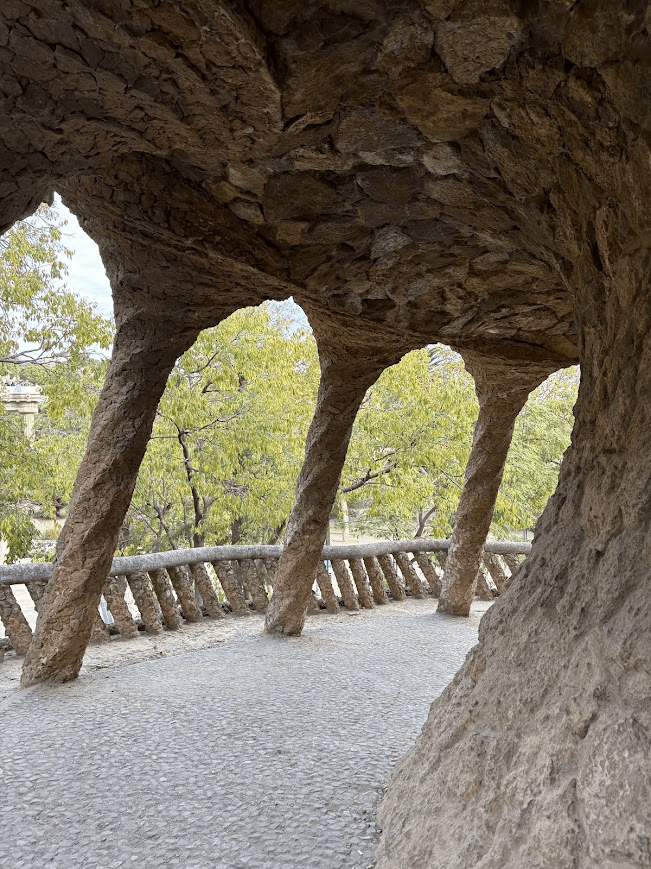
Anyway, we began exploring by following the path of Rick Steves (which we affectionately refer to as Ricky-Recommends). We climbed the steep hill to the cross (great views of the park and the city) and took the windy path back down to view more Gaudí architecture.
I find Gaudí’s work to be quite cool – albeit odd – but Park Guell was a level of crowded, even in the off-season, that stressed me to the core. I wanted to venture off into the adjoining urban park to enjoy nature with fewer humans, but my wife was starting to get hungry and feared getting lost. So, we finished our exploration – my favorites were the mosaic tiles on the ceiling and the stone columns that, if I remember right, was a driveway or parking area for the rich people’s carriages? – and headed out.
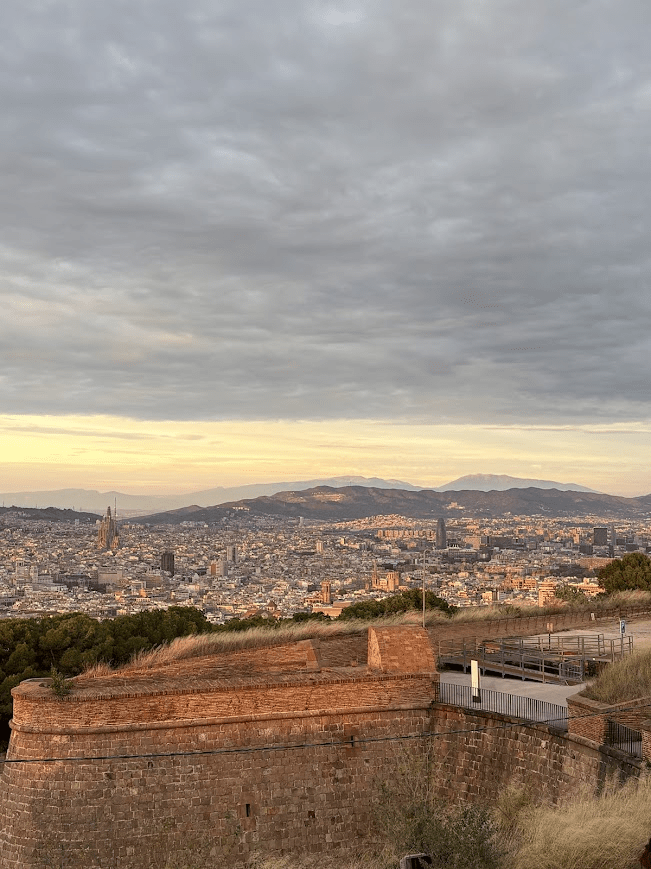
We climbed down the hill and walked about a mile to the metro, taking us back to the city center. Our afternoon plan was to explore Montjuïc Castle and the area; typically, you can take a Funicular (same fare as the metro) up the hill. Unfortunately, the funicular was closed during our visit, so we took the 150 bus. The bus was pleasant enough and offered a nice few of the Montjuïc area on our way up (take heed, those with motion sickness); the bus stops at the top of the hill, just below the castle.
On Sunday evening, the castle is free, so we passed through security and admissions; they handed us our free ticket and we entered the fortress area.
The castle walls offer an unparalleled view of the city (and the water) with a spectacular view of the sunset.
On our way back down the hill, we walked. A lot of the public park areas were under construction and closed off, but it was still a nice stroll with views of the water.
For dinner, we had made reservations at Tiberi Bar, a cool Mediterranean vegetarian-forward restaurant (still plenty of meat options). We found Tiberi Bar by recommendation from Fodor’s (see, we don’t just follow Rick Steves). With some time before our reservation, we first stopped at Bar Seco for a glass of wine. Bar Seco is also highly recommended for its food, but we only had time a drink.
It was our best meal in Spain; I may drool a bit thinking of it for years to come. They rotate through new menus seasonally, so it may not matter to share what we ordered, but our experience makes us believe that customers of this restaurant can do no wrong.
________________________________________
Barcelona Lez-Travel rating:
Three rainbows! We felt super comfortable being Out and Proud, and saw plenty of other queer couples during our adventures.
For our first afternoon in Dublin, we booked a free tour by Generation Tours and saw the top sights of Dublin, which helped formulate our plan for the week. We got dinner at the Oval bar, recommended by our tour guide. It was pretty good, but not the best meal we’d had, and a bit pricier than we thought it deserved.
From there, we headed to a pub recommended by the musician who played at our wedding!, and as promised, there was excellent music – The Cobblestone. It was crowded, and we could only fit in the back of the pub at first, which made it hard to hear the musicians, but every 20 minutes or so, someone would depart, and we’d sneak a bit closer.
Dublin Day Two: Howth
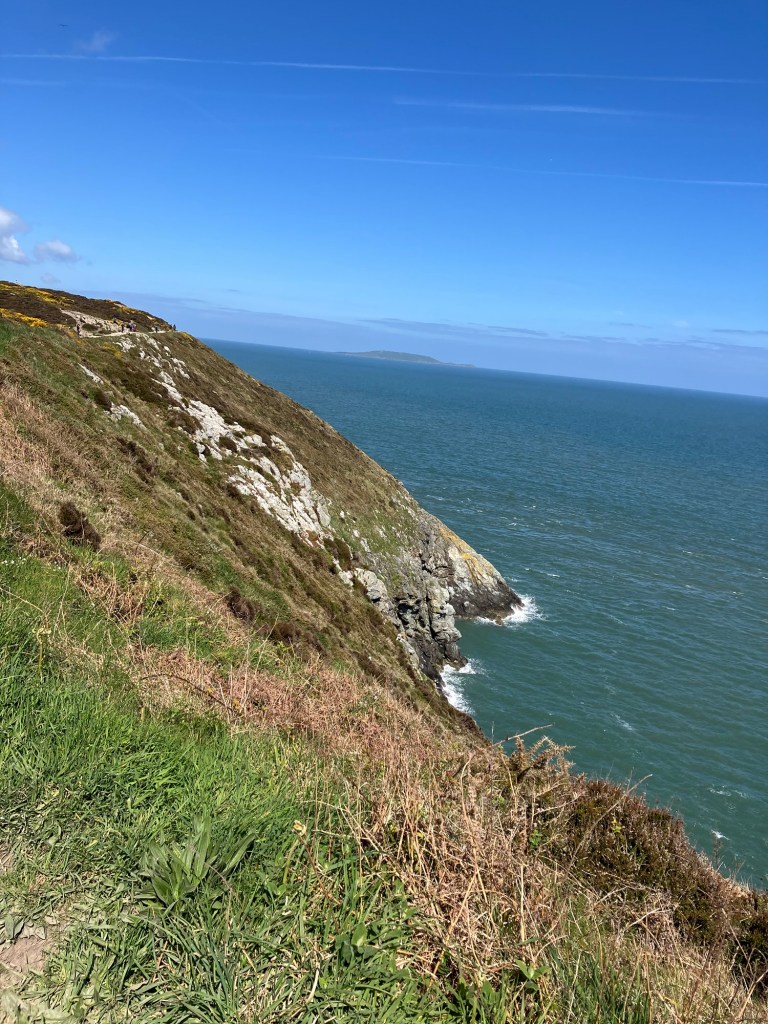
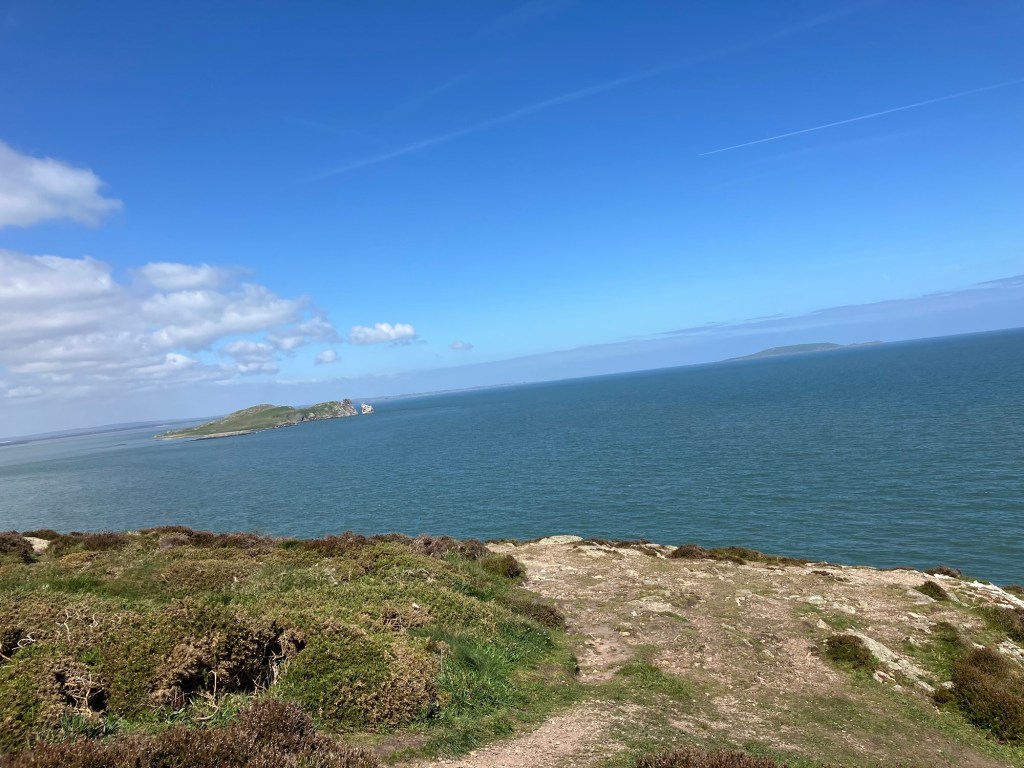
Howth is, if I dare say it, almost as incredible as the Cliffs of Moher, but minus the crowds. A little suburb on a peninsula off of Dublin, you can take the commuter train (the DART) there and back for 5€. There are four different loop trails to look at, and you can pick up the maps to each from the TI (about a 3-minute walk from the train station). We chose the second-longest, about 10km. We had planned to try the longest, but at only 2 additional km, it was way hillier, and most importantly, bypassed the Summitt (the mid-hike pub).
The hike takes you up a narrow sidewalk at first alongside gated, fancy houses and condos, but once you get to the top, the actual trail begins. There are several viewpoint detours, and the trail is well marked with the four different options (which all run together for the first half of the hike).
The views are absolutely incredible, and the first half of the trail takes you alongside the water (but way above it) for breathtaking scenery. As you near the lighthouse, the trails split, and those following the 8 or 10 km options are taken through town right past the pub. We didn’t eat, so I cannot comment on the food, but the pub had a great atmosphere, plenty of indoor and outdoor seating, and delicious beer options.
From there we followed the red markers, which took us through another hiking area that is popular with the locals and their dogs, so we had to pay closer attention to the trail markers to avoid getting lost. At the top of one of the hills, we had a beautiful view of Dublin, before hiking back down into Howth. We grabbed a seafood lunch at Crabby Jo’s, which had great smoked salmon and a delicious seafood chowder.
After lunch, we walked over to the Howth Castle, which now houses an automobile museum and cooking school (an interesting combination), but it was neat to walk around the grounds and see it. There are some paths near the castle and neighboring golf course, which are untraveled enough to make it seem like we were trespassing (we aren’t positive that we weren’t…).
That evening, we went to highly-recommended Darkey Kelly’s near the Temple Bar District. It was a bit disappointing, unfortunately; the food was OK, but overpriced, and in lieu of traditional Irish music, a band played Wagon Wheel (telling the audience that the song was called “Rock me Mama”).
On Wednesday, we took the Irish bus down to Trim to see the oldest Norman Castle in Ireland. We had planned to buy our tickets at the bus station with the promise of ticket machines that allow credit cards, but mysteriously all the machines were down, so we were forced to use the station ATM, which charged a fee in addition to an absurd exchange rate. (Until that point, we had gotten our cash at Bank ATMs only, which do not charge fees. Unfortunately, we just barely didn’t have enough euros for the bus fare!).
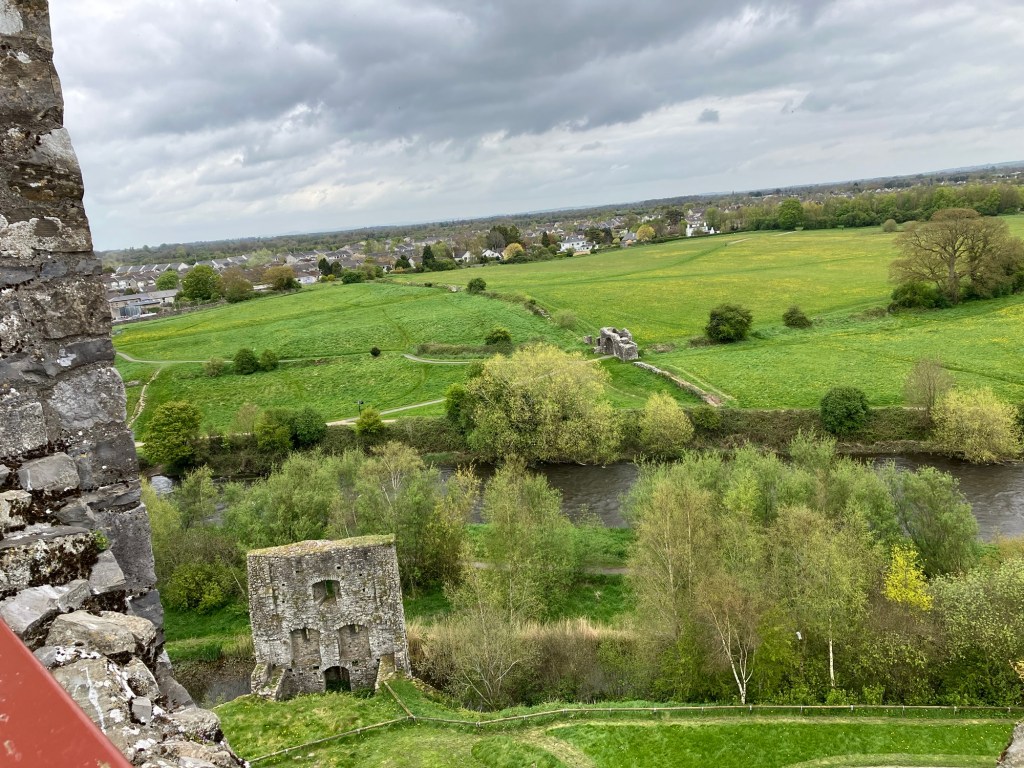
From the top of the castle.
The return ticket was 16€. We accidentally got off the bus one stop too soon, but it worked out as we took a long walk to the castle along the River Boyne. The River Walk was lovely, passing ruins along the way, and many locals with their dogs. Markers along the path tell the story of the history of the town. I would highly recommend the walk; not only is the path along the river lovely, but there are other medieval ruins to explore along the way.
We arrived at the castle behind a school group of about 50 kids, so we let them get a head start and took a quick Guinness break (it was almost noon). For lunch, we headed to a Rick Steve’s recommended (what we’ve begun affectionately referring to as Ricky’s Recs): Rosemary Bistro. My wife loved her burger, but unfortunately, the highly recommended tuna sandwich was really just a grilled cheese with a couple tuna sprinkles. (I should have taken a picture… when I say “tuna sprinkles,” I mean it literally.)
We headed back to Trim Castle and booked the next tour, which takes place every hour. While we waited, we explored the grounds. Though we had uncharacteristically sunny weather so far this week, our day in Trim was cloudy, but the impending drizzle held off for us to enjoy the outdoors.
The guide brought us through each level of the castle, sharing a bit about the history of the castle, what each of the rooms were used for. After about 45 minutes, we reached the top, awarding us with sensational views of the surrounding area. Our guide allowed us a few minutes to wander and enjoy the tower-top views before descending back down the narrow and steep windy staircase to exit back onto the grounds.
With about an hour until the next bus back to Dublin, we sought out a pub to relax with a pint. We discovered the hard way that before the height of tourist season and midweek, little was open, but we did stop into Sally’s for a pint of Guinness. We met other American travelers who had just begun their tour of Ireland following two weeks in Scotland, and enjoyed the artwork set into the heads of our Guinness draughts.
Day Four: Dublin Day
I had gone to bed feeling pretty beat and under the weather, so my wife allowed me to sleep in. I woke up about 8 minutes before the end of breakfast, which I take very seriously, so I threw on some clothes and ran downstairs to get my traditional Irish fare for one last time.
Feeling better after some beans, eggs and a croissant, but still tired, we adapted our Dublin Day to hit the minimum. We had wanted to tour Kilmainham Gaol. Ricky’s Recs had warned us to reserve in advance during the high season, but since it was only mid-April, I figured we’d luck out. Unfortunately, we did not!
Instead, we headed to the National History Museum, exploring the Iveagh Gardens and St. Stephen’s Green along the way. The National History Museum is free, and has enough to entertain folks for hours; we, however, focused on the main galleries for an hour, before heading out for some lunch.
We headed back to a pub featuring live music that my wife had noted earlier. It had a lovely patio, but as the cold rainy weather finally arrived for us, we ate and drank indoors (plus, the music was inside!) We ordered a toastie with some tomato soup and enjoyed the music. Even at a mostly empty pub at two o’clock in the afternoon on a Thursday – the musicians were quite talented. Here, we met more Americans; the wife was quite friendly, but the husband drowned out the music with his unending talk of golf courses, so we kindly took our leave and headed out.
We attempted the Brazen Head next; it was our Dublin tourist day, after all, but we balked at the food prices and instead settled for a pint on the beer garden. The indoor area was quite crowded, and though it was cold outside, the atmosphere was a bit calmer. From there we headed for our final Dublin meal, ordered much of the same that we would have eaten at the Brazen Head… but for half the price.
Then back to the hotel to pack up and roll out!
Dublin Lez-Travel rating:
Rainbows and gay bars are all over Dublin. We felt safe, and unlike Galway-area, not the only ones.
We were fortunate enough to be sitting next to an off-duty Irish flight attendant (also gay), who not only provided sound advice for our trip, but also asked her friends for better wine and whisky than what they serve by default.
We landed in Dublin at 6:00am, flew through border control. We caught our coach (we used Dublin Express) to the Heuston Station, where we ate a full Irish breakfast – our first of many – and boarded our train to Galway.
We booked a room at the Hardiman Hotel next to the train station and just off Eyre Square. It is a beautiful old building and lovely hotel, but fair warning: the rooms were HOT. The ancient windows made our hotel room into a greenhouse, as the uncharacteristically sunny days we enjoyed baked our room to over 80 degrees. The glass was hot to the touch and we could smell our curtains burning against it.
But otherwise, our stay in Galway was lovely. Once we arrived, we strolled the riverwalk while we waited for our rooms to be ready, enjoying the nice weather. After checking in, we grabbed dinner at The King’s Head, where I had my first of several Beef and Guinness Stew (mouth-wateringly good). And my wife, self-proclaimed fish and chips aficionado had the best she’s ever had. It was a somewhat pricey place, but the food was well worth the cost.
We crossed the street to Tig Cóilí, which featured traditional Irish music in the evenings. The pub was crowded, but we lucked out with bar stools near the back and enjoyed the music.
What we learned about trad music sessions: many of the musicians don’t know each other and don’t play together regularly. Typically, any musician is welcome and can bring their instrument to join in. No mics, minimal singing and almost entirely instrumental, we observed musicians of all ages (as young as 18 and as old as perhaps 75) come together. One musician will begin a song, and one by one, the others join in. This was my favorite part of our experience in Ireland, where instead of shitty music blasting or mediocre DJs, there is live, talented and free music in almost every pub on almost every night, particularly in Galway, played by musicians just because they love it, with seemingly the only payment of a couple free drink tokens.
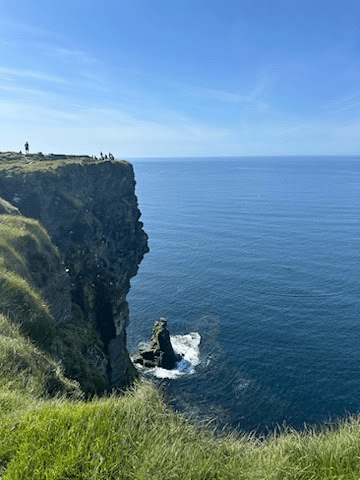
On our first full day, we joined a tour company to explore the Cliffs of Moher. Our tour guide was a bit eccentric, but he got us from point A to B (dangerously dodging bikers participating in a cross-county bike event). We chose the tour with Galway Tour Co. because they offered the most direct route to the cliffs, and the longest amount of time to explore (two hours).
The path alongside the cliff is very narrow, barely wide enough for the two-way traffic, which made for a frustrating initial hike with fellow tourists packed in to get a glimpse of the UNESCO World Heritage site. We hustled as fast as possible down the path, stealing only a couple of glances at the cliffs, until we had hiked about half a mile and the crowds thinned out considerably. If we’d had more time, we would have loved to hike to the end and back, but unfortunately, most of the tour options are built around the philosophy of “here’s a thing to look at,” then “here’s a place to eat” then “here’s a quick stop for a selfie” and not built around allowing time to actually explore and experience.
From there, we boarded the coach to Doolin for lunch. Now that we know what we know, for our next visit, we’ll take public transit to Doolin and begin the Cliffs of Moher hike in town, instead of at the overcrowded Visitor Center. In Doolin, we ate at McGann’s Pub,which had a delightful smoked salmon salad, and the best chips (fries) that we had in our time in Ireland. I finally ordered my first Guinness, which truly is worlds better in Ireland than American, even though we were across the country still from the brewery.
Day Three
On Sunday, we booked a ride on the ferry to Inishmore (Aran Islands). Related to what I said I’d do differently with the Cliffs of Moher, if we had made Doolin a home base for the cliffs, I would have done the same for the Aran Islands, taking the ferry from Doolin to Inishmere, the smallest island.
Instead, we took a coach from Galway to Rossaveal to board the ferry to the largest island. The coach was a bit under an hour, the ferry 40 minutes. We reserved bicycles on the island from Aran Bike Hire, and it was a total clusterfuck with the entire ferry filled with tourists running to grab the bikes and begin their adventure. I had to go through three bikes before I found one with sufficient air in the tires, but it had plenty of other issues (loose brake calipers and jumpy shifters, for starters). But, the price was reasonable and the bikes got us to where we needed to be. (Next time, however, I’ll try the other bike rental company, Inis Mor Bike Hire, which is also right by the pier).
We took the low road first to be able to see the seal colony at low tide. Fortunately, as we are regular bikers, it didn’t take us long to get ahead of the crowds and families, and we enjoyed our ride more once we got out of the thick crowd and ahead of the horse-drawn carriages too (passing them was very scary though!).
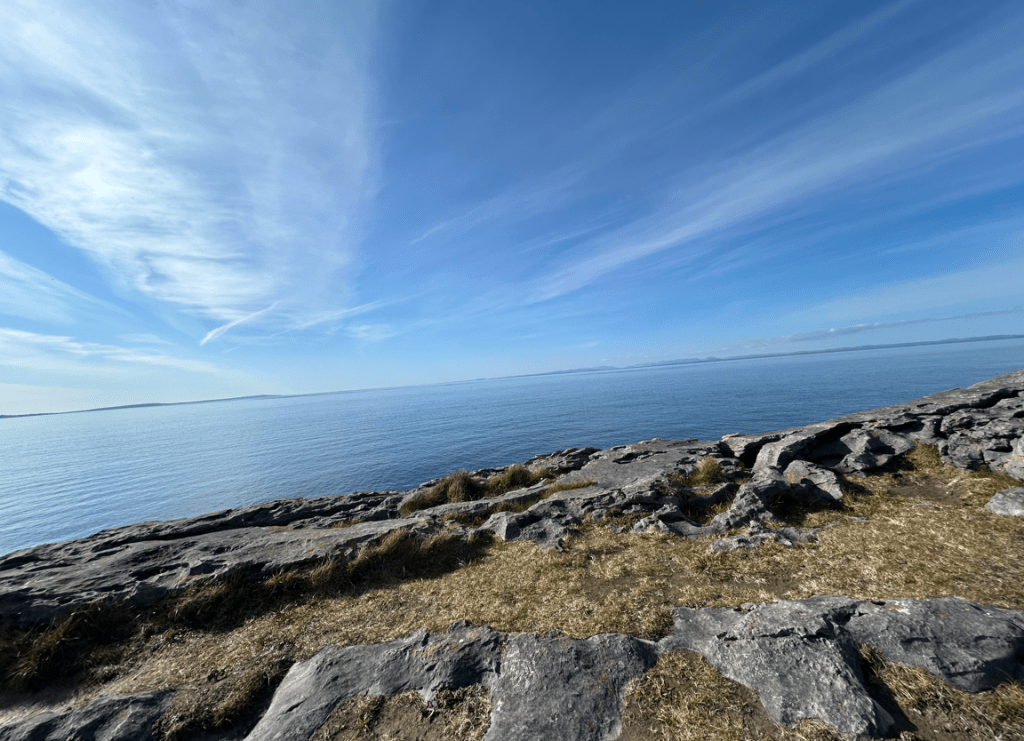
The views in Inishmore were absolutely gorgeous. We biked the five miles or so to the Fortress (Dun Aonghasa, 5€). It’s a climb on foot up to the top of cliffs where the ruins sit, harboring gorgeous views. Careful: there’s no fence or railing between the fortress and to the rock and ocean below!
We sat in the sun and enjoyed the views for a while, until the crowds we escaped on bike began arriving. We hiked back down to our bikes and took the high road back towards the port. On the high road, instead of passing the carriages, we were passed by tour buses. Typically at safe speeds and distances, but a few gave no fucks and flew by us, likely to pick up their customers at the fortress.
We stopped at Joe Watty’s Pub. It was a delightful place, and not very overpriced despite the tourist crowds (our menu was for “low season” though, so this may not be the case during the summer). We had another seafood salad that was just as delicious before headed back to town. We had an hour to explore before our ferry departed, and we tried to bike out to the Black Fort, but with steep unpaved roads, we couldn’t make it with our dinky city bikes. We made a mental note to reserve mountain bikes next time. We boarded the ferry early to snag a spot on the roof (outside, where downstairs was indoors).
That night, we hit our favorite pub of our time in Galway: Tigin. The bartender was an absolute delight, and the musicians for the trad music session were wonderful. It wasn’t overly crowded, either, so we had a seat and could enjoy the tunes without drunk Irish students or loud Americans bumping into us.
On Monday morning, we enjoyed our last hotel breakfast (which had been delicious. If you risk the hot rooms to stay at the Hardiman, definitely get the package with breakfast). We walked to the train station and headed back to Dublin!
Lez-Travel Rating for Galway:
While we didn’t see any obvious display of pro-LGBTQ culture, we explored and didn’t need to hide that we were together; no one made any comments or gave us judgmental looks. A few establishments had rainbow flags, but not many. Going outside of the city and into the country did not feel as stark of a difference as it does in many U.S. metro areas (like Columbus), either. We didn’t feel out of place in the less urban areas outside of Galway. We did a few tours, and both times I believe we were the only gay couple in the group, but all the tour guides were friendly and accepting.
What better reason to travel to the South of France than the marriage of two good friends? We booked our travel into Paris, with the high speed train to the region of Provence. The wedding took place in a small town in the countryside of Provence.
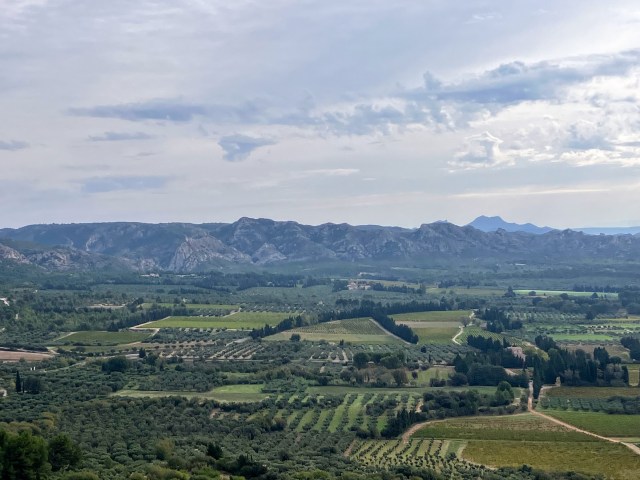
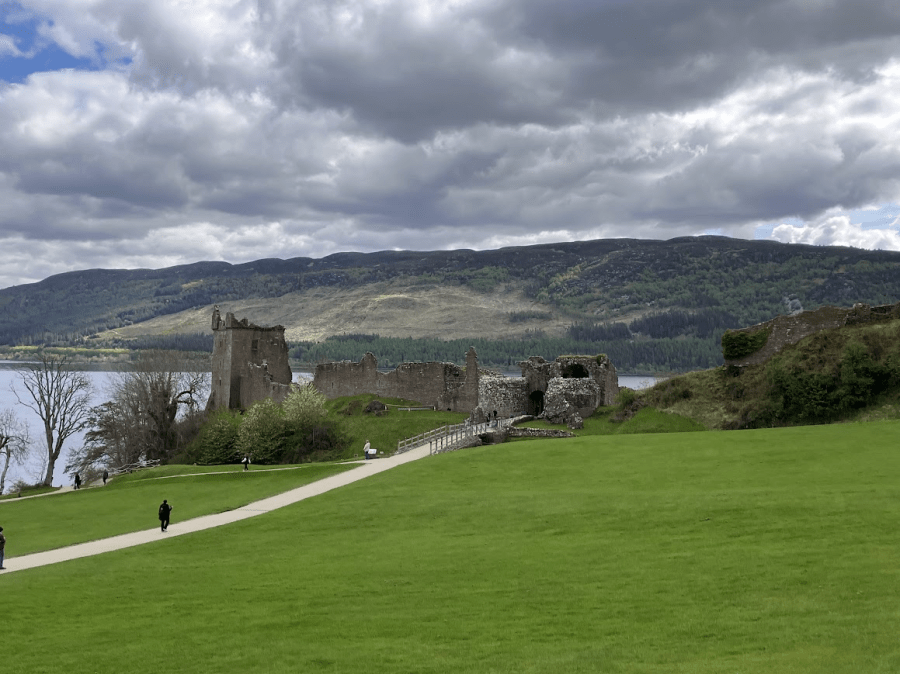
The day of the wedding, we had some time to explore before returning to get ready for the festivities. We headed to Les-Baux-de-Provence, a small village in the Alpilles mountains, situated beneath the ruins of a large medieval fortress, Chateau des Baux. We paid to park at the bottom of the hill and began the trek up the mountain.
When we made it to the top, we stopped to catch our breath before roaming along the edge of the cliffs to enjoy the magnificent view. In fact, we enjoyed the view for too long that we had to abandon our plans to pay to enter and explore the chateau, and instead began our trek back down the hill to head out.
Our next task was to drive back down the winding roads to St-Remy-de-Provence. Wednesday is market day in St. Remy, a massive collection of vendors that stretches through a significant area of the town. The bride had requested we purchase some lunch snacks for her – and did the same for ourselves. Fortunately, our friend was with us who spoke conversational French (my wife and I – far from it) and helped us purchase a diverse selection of cheese, meats, and bread.
At a cost of only 40€ (also about $40 at the time), we purchased enough cheese and meat to feed the entire bridal party and ourselves (four of us, about 10-12 people overall). And the quality – far from anything I have enjoyed in the States.
Despite the notion that the French hate Americans (honestly, due to my interaction with American tourists, I don’t blame them), that was not our experience in the southern countryside. The vendors were incredibly friendly to us, and were thrilled that one of our party spoke French. The vendors would correct small errors with a smile, and thank us. They even let us sample every cheese before we made the purchase! And I mean – decent hunks of sample cheese, and one for each of us.
Following the wedding festivities, my wife and I and our two friends journeyed on to Cassis, along the coast in the southern part of the region. My wife and I had rented a car, as Cassis and the town of the wedding were not easily accessible by train (due to the mountains, the train station in Cassis is 2 miles from the town).
[*A note on driving in France, as we made a couple of mistakes: 1) the speed limits aren’t suggestions like in the States. If you go even 2 km/hr over the speed limit, you could get a ticket. And you won’t get pulled over; there are speed violation cameras that will automatically send a bill to you – a whopping 135€ – if you aren’t careful! and 2) it’s illegal to turn right on red. Did we turn right at a red light? Yes. Did we get pulled over immediately? Yes. We were pulled out of the train station/rental car parking lot… fortunately, the police officer only shamed us a bit for not knowing the rules (fair) and did not give us a ticket.]
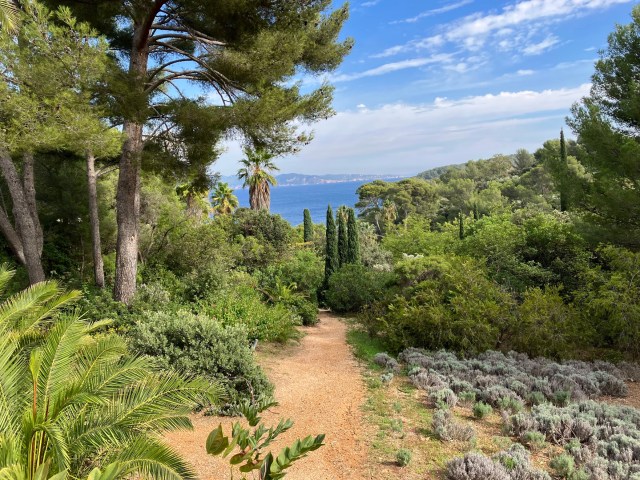
Wanting to check out La Route de Crêtes, a remarkable 30-minute drive along the seaside cliffs linked Cassis to La Ciotat, my wife and I drove first to La Ciotat, and explored a botanical garden, Parc du Mugel. A reasonably priced pay-lot is nearby for parking, then a 10-minute walk down a steep hill and past a beach will bring you to the park entrance.
The park was beautiful, and entry is free. It had lovely views of bay, and vegetation I did not expect to see in France (bamboo!? Palm trees!?). At the top of the hill, you’ll also get a beautiful view of the Calanques.
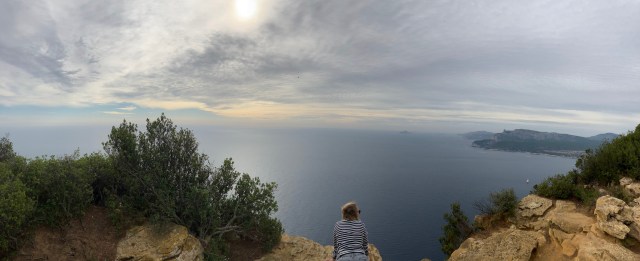
Once we got our fill of the park (hardly… I could have wandered there all day), we headed back to the car to start La Route de Crêtes. It definitely lived up to expectations. Though a somewhat scary drive at times (a VERY narrow, winding road), the views were breathtaking, and there were plenty of places to pull over and take in the views from outside the car. This one was our favorite lookout spot.
Once we arrived in Cassis, we found our hotel with some effort. An amazing thing about these towns in France is that they close off smaller streets and alleys during market days or dinner time, so that restaurants can use those areas for outdoor seating. But – the closed roads did make it tricky to get to our hotel! We ended up parking up the hill and dragging out luggage to our hotel, just off the city center. We stayed at a new Best Western; the rooms were very small and simple, but the price was reasonable and location was perfect.
We met our friends at a Rick Steves’ recommendation: Divino, a small and reasonably priced wine bar. The bartender was very friendly, and handed us some free charcuterie and olives to enjoy with our wine. He had three house selections (one white, rose, and red, all local) already selected and open, 7€ each, so you could select something without too much pressure and need to struggle through a French menu.
The next morning, we once again enjoyed market day (Fridays in Cassis). Though not as expansive as St Remy, the market still had much to offer, and we purchased cheese and bread to enjoy on our Calanque hike.
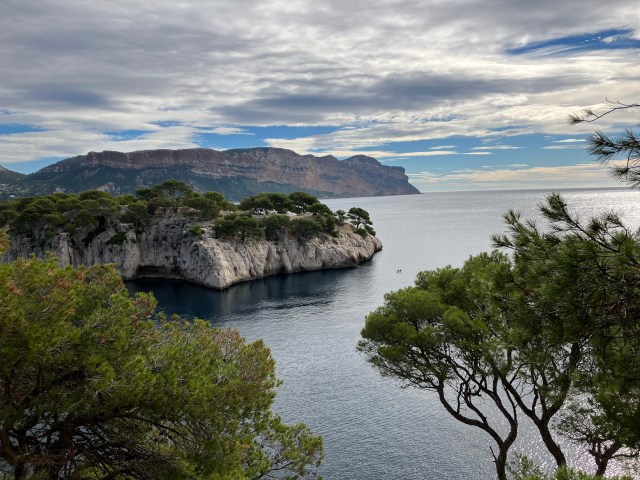
The Calanques: calanques are narrow valleys with sea inlets, surrounded by cliffs. Near Cassis, there are three notable Calanques: Port-Miou, Port-Pin, and d’En-Vau.
Port-Miou is a thirty minute walk from the Cassis city center, and it is a climb. You walk up from the port and through the wealthier part of town, so don’t forget to turn around and enjoy the view as you go (you may need to catch your breath anyway!). At the edge of town, you hike down a bit to reach Port-Miou.
View from in between Port-Miou and Port-Pin
A large sign for hikers show the other paths to the next two calanques. One route is steep and rocky, the other travels around – longer, but more gradual and more accessible. Even in the off-season (mid-October), the trail was quite crowded, so if you go in summer, start early!
We made it to Calanque Port-Pin in another twenty minutes from Port-Miou. The views were spectacular, and the small peddle beach beautiful. We got a later start than intended, and knowing it was another hour to Calanque d’En-Vau (each way), we bailed on seeing what is said to be the most beautiful of the three (next time!), and headed back. Exhausted from the hike and heat, we were thrilled to discover an offer from our hotel: since it was new, they offered each guest a free 1-hr private use of their spa. Fully recovered, we met our friends at a wine bar, La Maison de Jo et Gaby. We had intended to follow another Rick Steves recommendation, La Chai Cassidain, but sadly it no longer existed and had been replaced, in the same location. Nevertheless, it was delightful; we grabbed a small table in the alley and the bartender handed us a small menu with that day’s options for wine by the glass. The bartender understood English but spoke only French, taking time to help us with the pronunciations. He refused to pour my wife’s glass until she was able to pronounce the name of the wine correctly!
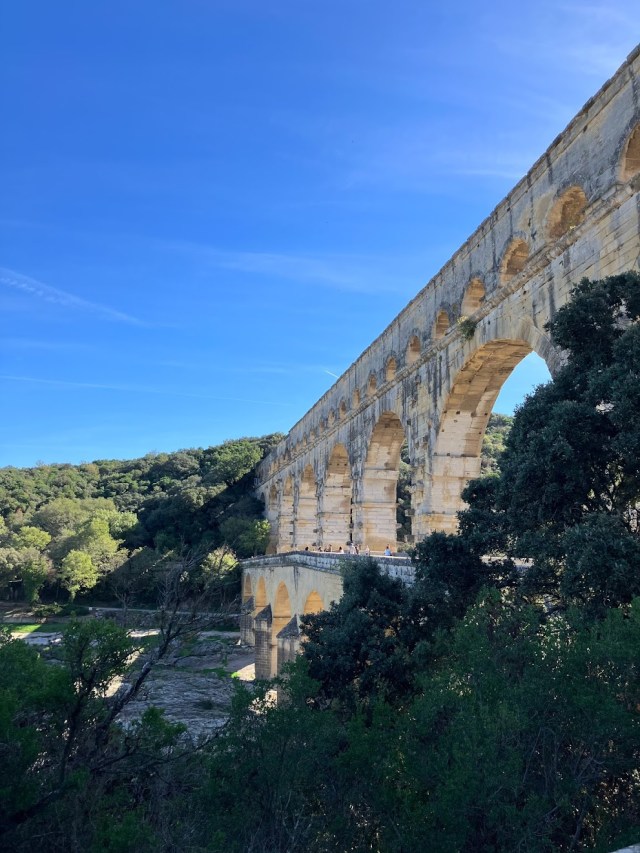
For our final destination, we headed to Nîmes, stopping first at Pont du Gard, a massive, 30-mile aqueduct designed by the Romans to provide fresh drinking water to Nîmes. In fact, it provided nine million gallons per day.
We had to return the rental car that afternoon and only had an hour available to explore Pont du Gard, but if we could do it again we’d allow 3-4. There are tours available and plenty of walking trails to get better views of the aqueduct. You can also rent kayaks to view the Roman sight from the Gardon River.
In Nîmes, we had a casual first night, picking up some pizza and heading to our airbnb to watch the Tennessee v. Alabama football game (Go Vols!). The next morning, we headed out to enjoy a full day of touring the city. Rick Steves mapped out a full day’s tour for Nîmes, complete with recommendations on where to eat.
The day started with the Roman Arena. We purchased the culture pass there, which provided us entry into all the roman monuments and the museum. The arena, much like the Colosseum in Rome, was pretty incredible to see firsthand. The climb to the top provided amazing views of the entire city as well. The audio-guide, though showcasing some over-enthusiastic voice-acting, was still quite informative.
From there, we walked across the street to the Roman World Museum. The museum was interesting, displaying thousands of Roman artifacts in the three-level, bright building. It’s worth a see if you have the time, but if you’re short on time, I’d recommend focusing on the Roman monuments.
The restaurant Rick Steves recommended was no more, so we hit up another place in the recommended square: Place du Marché. A note on eating in France – it takes a WHILE. Though the food is always incredible, meals are long, social events, even when you’re trying to simply grab a quick snack and coffee and then head out to sightsee (as we were hoping to do in Nîmes!). And if you’re hungry between 3-7pm, you’ll have a hard time finding food. Most restaurants serving dinner do not even open until 7:00 or 7:30pm.
From there, we continued the Rick Steves walking tour, heading to Maison Carrée. Dated back to AD4, the Maison Carrée is a stunning temple that’s stood the test of time, being consistently utilized for a variety of purposes since the Roman Empire. From there, we headed to the Fountain Garden, a lovely park (free entry) and the Temple of Diana, which is within. Finally, we walked over the Castellum, a small site on a residential street which is the end of the 30-mile aqueduct from Pont du Gard. And how about this: based on the water available, the lower holes serviced the wells of the neighborhoods. The higher holes – so, only when water was sufficiently available – serviced the homes of the wealthy. How’s that for equity!?
After our walking tour, we grabbed a pint (we had been drinking so much wine, as is customary, that we had really missed our beer!). We sat at a table outside, casually taking in our view: the massive, 2,000 year old arena. How the locals could get used to that is beyond me!
After our casual pint, we went around the corner to a bar with dozens of beer on tap, including many unique Belgians (which we looooove). At this bar, you could pour however much you want, so if you don’t want to be dragging yourself home after too much Begian tripel. And small pours means you get to try more!
To wrap up the day, we headed back to our airbnb to pack up and rest, needing to catch the 5am train back to the Paris airport in the morning.
Lez-Travel Rating for Cassis:
I felt a little out of place in Cassis, but it wasn’t because of my queerness. It was a huge tourist spot, and though winding down for the season, was still thriving with tourism. Perhaps it was more my socioeconomic status than my queerness, though the costs weren’t extreme, the town felt… uppity? I would go back for the nature and beauty that surrounds Cassis more than the town itself.
Lez-Travel Rating for Nîmes:
While we didn’t experience or see much LGBTQ culture (though in fairness, we didn’t seek it out), we wandered the city hand-in-hand without fear of harassment or hostile looks. Some establishments had the Pride flag hanging, including where we got our post-walk beers by the Arena.
Resources:
For our travel plans, we used primarily Rick Steves Provence & the French Riviera. We bought a used, older edition for cheap, (which I’m sure is why some of his recommendations had since ceased to exist). My favorite part about the Rick Steves book for this trip was him outlining a day-long walking tour in Nîmes. It saved us from planning out and estimating how much time each location would take, and we just followed his guidance and it was perfect!
Traveling can be a difficult passion for those who have a demanding and/or low-paying job (speaking from my own experience working in the nonprofit/education field). It was important for my wife and me to travel for our honeymoon, something we had not done yet together due to post-graduate schooling, long-distance, and a wealth of other factors circling around finances and, well, being gay.
Our first “vacation” together was after four years, a gift to ourselves when my wife completed her PhD, purchased on significant discount from Groupon. Well, the resort was mediocre at best, but we enjoyed the beach and the sunshine, that is, until we suffered drastically from food poisoning on the third day.
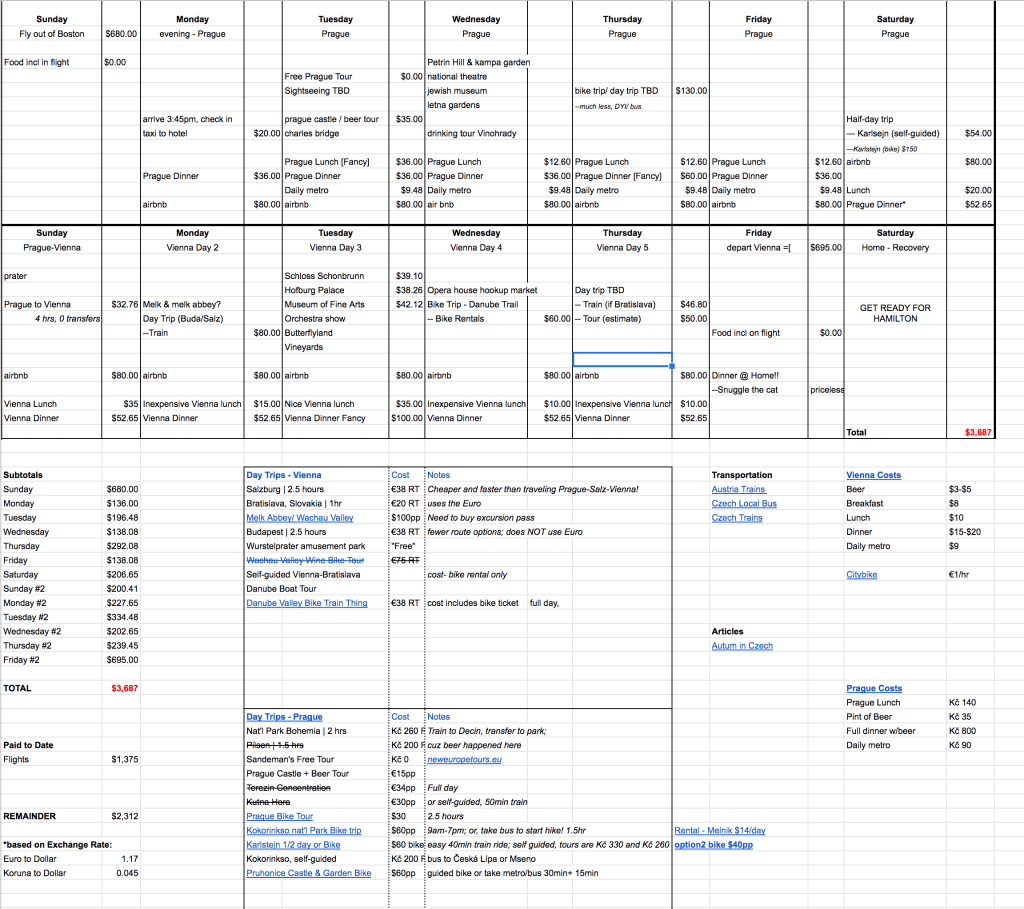
But I digress. This complex budget is where I started…
I like planning, though our actual activities varied significantly from our plans! In fact, we spent about $500 LESS than this initial budget.
It might be surprising, but this was step one. I included everything we were interested in doing, so it could be a part of our wedding budget, and scaled back from there. I researched day trips that were reasonable, I calculated from the local currency to the dollar, I even looked up average cost of meals so I could determine how many days we could “eat fancy.” To decide where to go, we researched countries of interest and looked at the cost to fly there and average cost of accommodations. Central Europe was our focus, and flying in to Prague and out of Vienna was the most reasonable, and, according to our research, among the most gay-friendly.
Note: In Prague, we didn’t see many lesbian couples, but we always felt safe and not out-of-place, especially in the Vinohrady area. Only once did someone do a double-take at us, but it was at the Charles Bridge and it was a man in a University of Alabama hoodie. In Vienna, gay and lesbian folks were everywhere! I’ll go more in depth in other posts, but definitely a space we felt not only safe, but… a part of the norm. More so than in Boston!
My tips:
Stay in an Airbnb – take note that some have cancellation policies and some don’t.
Use public transit/ City bikes
Stay away from touristy areas for meals
Travel off-season
Many tourist destinations have free or discounted days or times (for example Prague Castle)
Following a painfully long layover (saves money!), we landed in Prague on Monday afternoon. One thing we agreed to splurge on – taxi service from the airport. Our Uber was not much, and saved us time and headache trying to get from the airport. Typically I’d swear by public transit, and I’d recommend this video to see how.
We arrived in time to check in to our airbnb. In searching for our airbnb, we were pretty flexible on the location because we knew we planned to visit a different part of the city each day. We researched primarily safety and cost, and actually, lucked out with a large studio apartment in the Old City, where we were close to a few major tram lines and could walk to the city center.
Besides the airbnb, our biggest money-saver was THE WEATHER. This may seem unfair, because obviously there is nothing one can do to plan around weather until it’s happening. As you can see on my ridiculous budget spreadsheet, we planned for many museums and attractions. In Prague, there is so much to do outdoors that is free. Our favorite was the Vyšehrad (Prague’s “other castle”). We toured some caverns for a couple bucks each but the grounds and rest of the castle was free. There are a couple restaurants where we enjoyed a cheap beer outdoors. We spent the entire afternoon wandering around, and spent maybe $5 (yes, that includes the beers).
The second biggest money-saver was… WE LOVED PRAGUE AND VIENNA. Seriously. There are dozens of awesome day trips in a 90 minute radius, and we planned to do 1 or 2, but there was so much to do in Prague and we loved every day so much, we had no desire to leave the city. If we go back, I have this list to refer to, but 5.5 days in Prague was not even enough. Once we leave the city-center, there are multiple other neighborhoods each with a distinguished and unique character. And I would recommend the same. Don’t spend all your money trying to cram the entire country into a few days, and spending that much more time on trains and buses. Guided day trips are expensive. Pick a spot and stick to it, well enough to get to know it. The most money we spent in Vienna was the day it rained (we went to museums) but avoiding the day trips was actually our best financial decision.
There are always free guided tours. One company I have used often is Sandeman’s New Europe tours, but other companies do guided tours for free as well. Yes it’s “free,” but please please please, always tip your tour guide.
In Vienna, we stayed in Wieden, which according to our research was not the most gay-friendly area, but we found it to be very inclusive. It was a quiet but hip neighborhood with lots of young folks, and major bike lines into the center of the city. The cost of our meals and airbnb was definitely much more than Prague, but still significantly less than Boston and other major US cities. The most money we spent on dining was US$75, including tip, tax, two entrées and three alcoholic beverages each. This was our one big “fancy” meal, I mean, we were not trying to be frugal, and we left tipsy, full, and happy on one of the best meals of our life. (In Boston, $75 would get you two beers and two burgers.)
The same meal in a touristy area of Vienna, however, could have been double that. So, my recommendation in that respect is to avoid dining in the city center. Grab a beer and snack if you’d like, but save the dinners for other neighborhoods – you’ll get a more authentic experience that way, anyway!
As most vendors prefer cash payment, we typically used cash during our stay. The ATMs of banks do not charge ATM withdrawal fees – so keep that in mind, as that is a cost that can add up quickly! Be sure to take note of your own bank, too, if it has international fees.
I wrote above that we spent much less than we budgeted. Again, this is primarily due to our outdoor activities in place of admission to museums and other major attractions. Flights were $680 each (round trip); airbnb was $85/night in Vienna and $75/night in Prague (that includes ALL costs: base cost, cleaning fee, Airbnb service fee, and tax); meals, attractions, Ubers, beers, wine, public transit, EVERYTHING ELSE totaled $900. That’s $33 per person per day in Prague. It’s $52 per person per day in Vienna.
I have always liked Austria, though I couldn’t tell you why exactly, as this was my first trip to Vienna. In college, I visited Salzburg while interning abroad in London (10/10 would recommend Salzburg to a friend, but this post will of course focus on Vienna).
So when our train pulled into Vienna from Prague, we quickly headed to our Airbnb to check in then explore our neighborhood, staying local our first evening.
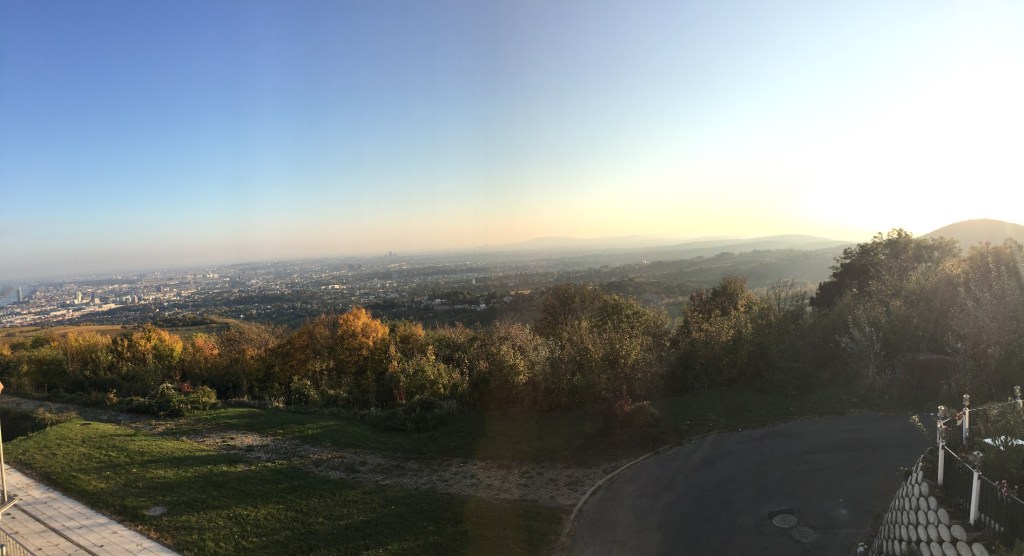
Our first full day, we wanted to check out the vineyards in the hills overlooking Vienna. We started by taking a city bus (38A) to the top of the mountain – Kahlenberg – a cheap and direct route to witness beautiful views of the city. It’s a windy road; if you get motion sickness, be warned, and grab a spot near the front! There is both a fancy restaurant and café here at the top, and the option to take the same bus back into the city, but what I’d recommend is taking a hike.
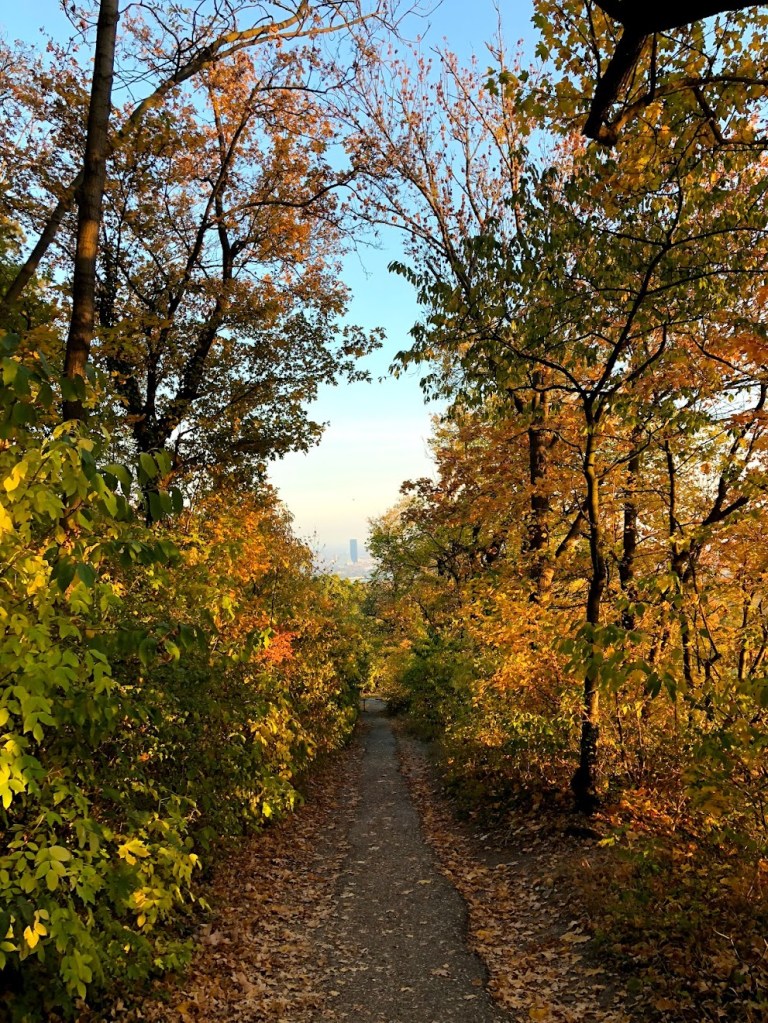
It’s about two miles from Kahlenberg to Grinzing. Grinzing is a neighborhood of Vienna and is the heart of Vienna’s wine scene. You can reward yourself (as we did) following the 2 mile hike with a visit to a Grinzing restaurant or Heuriger (wine tavern).
Some of the smaller Heurigen have limited hours, and we passed many of them during our hike down the mountain. They spread dozens of picnic tables out across their patios or grassy areas, but unfortunately for us, many are only open on weekends outside of summer. So we settled for one in the area of Grinzing that had weekday hours.
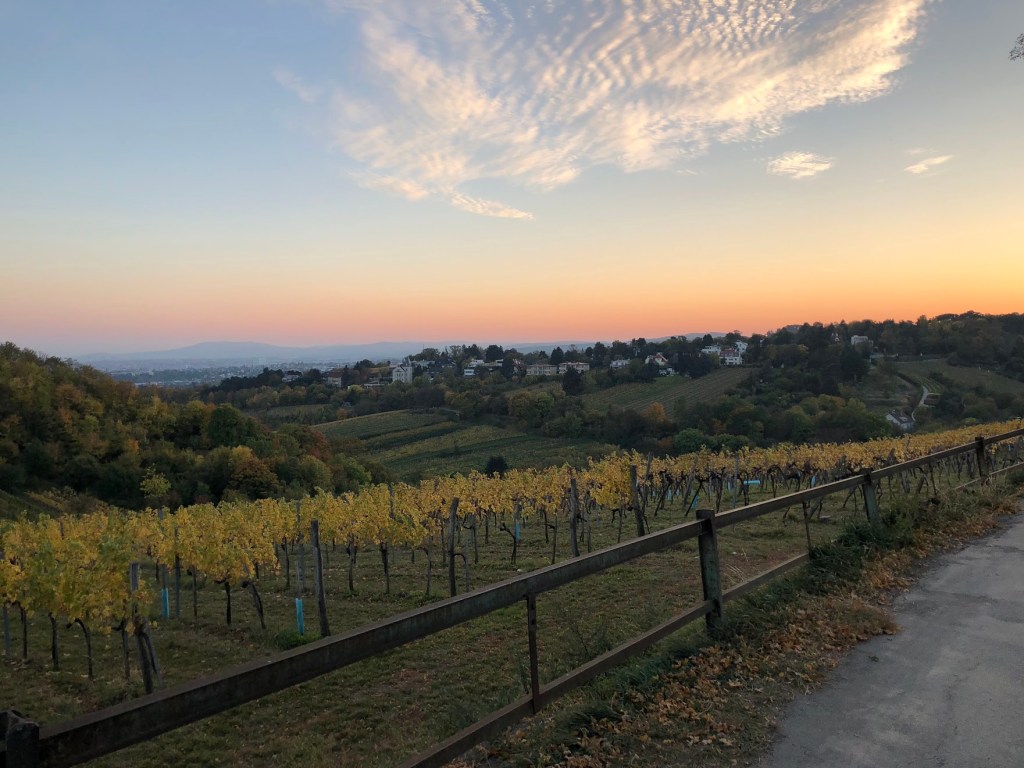
We started our hike a bit later in the day than we should have done, and as the sun began to set the woods got a little dark. We didn’t have cell service, but fortunately, everything is well marked and the very moment we began to worry, a sign pointed us in the direction of Grinzing. We took that last bit along the road to have light, but not before capturing this gorgeous picture of the sun setting over the vineyards.
On our second day, we rented the city bikes. You will need to register an account on the first day, which we did a week membership for a whopping 1€. When you pick up the bike, the first hour is free. From there, it’s only 1€ per hour.
Vienna is a biker’s dream. With mostly protected and/or off-road bike lanes, you are wildly free from worrying about get hit by a car. You do want to look out for pedestrians, as, especially in the city center, many tourists are confused and walk in the bike lane instead of the sidewalk reserved for pedestrians… I could go onto a rant about it not being that hard, signs for bikers vs. pedestrians is pretty universal and do not require proficiency of German language, but – I’ll just leave it at that.
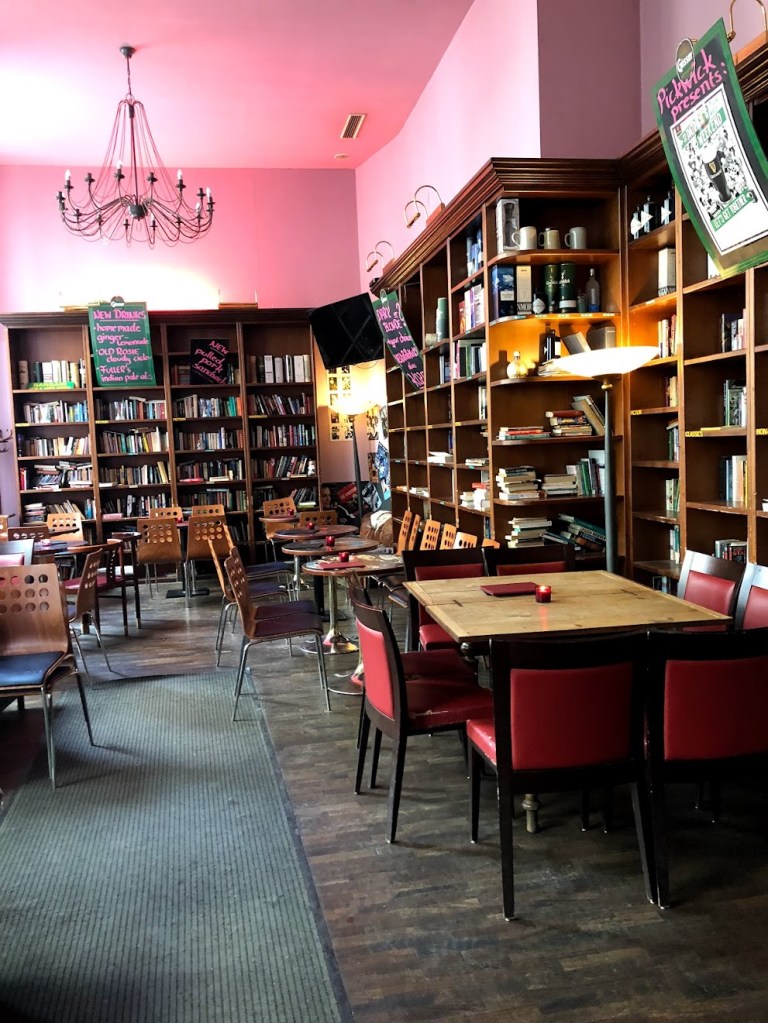
When our free hour was up, we docked out bikes and found this cute English pub that doubled as a library bookstore. This is what we had been hoping the “book bar” place in Prague would look and feel like, and this pub was comfortable and delightful.
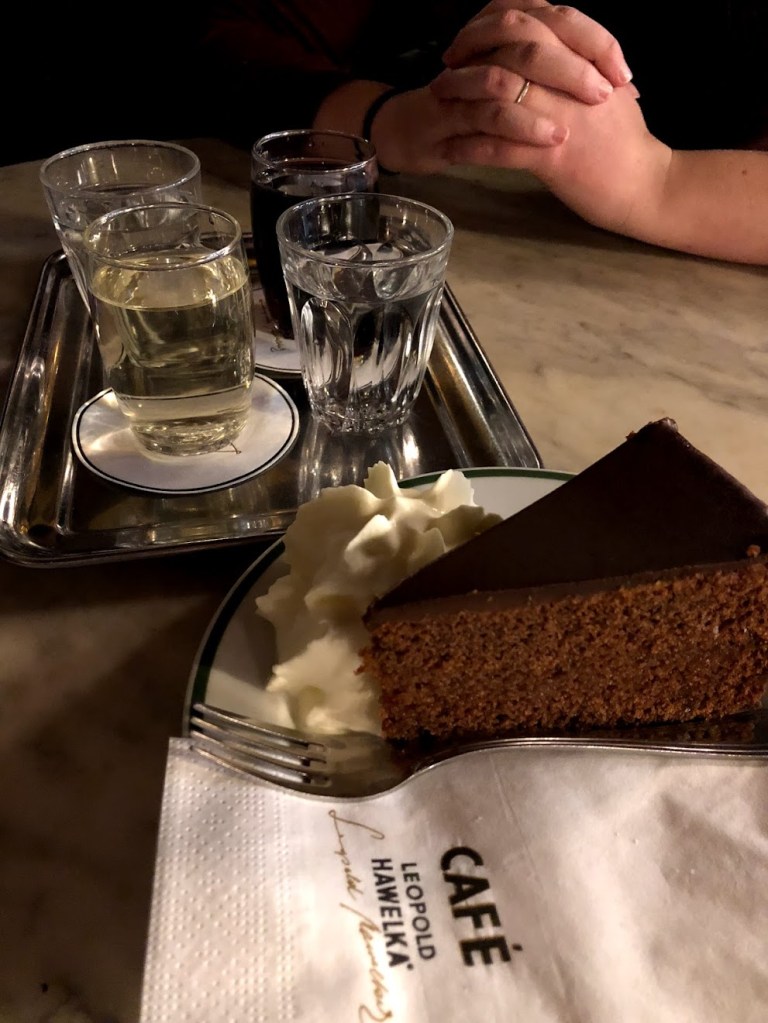
While in the city center, we also indulged in the notorious Austrian cake, the sacher-torte, a chocolate cake layered with apricot preserves. Accompanied, of course, with some Viennese wine.
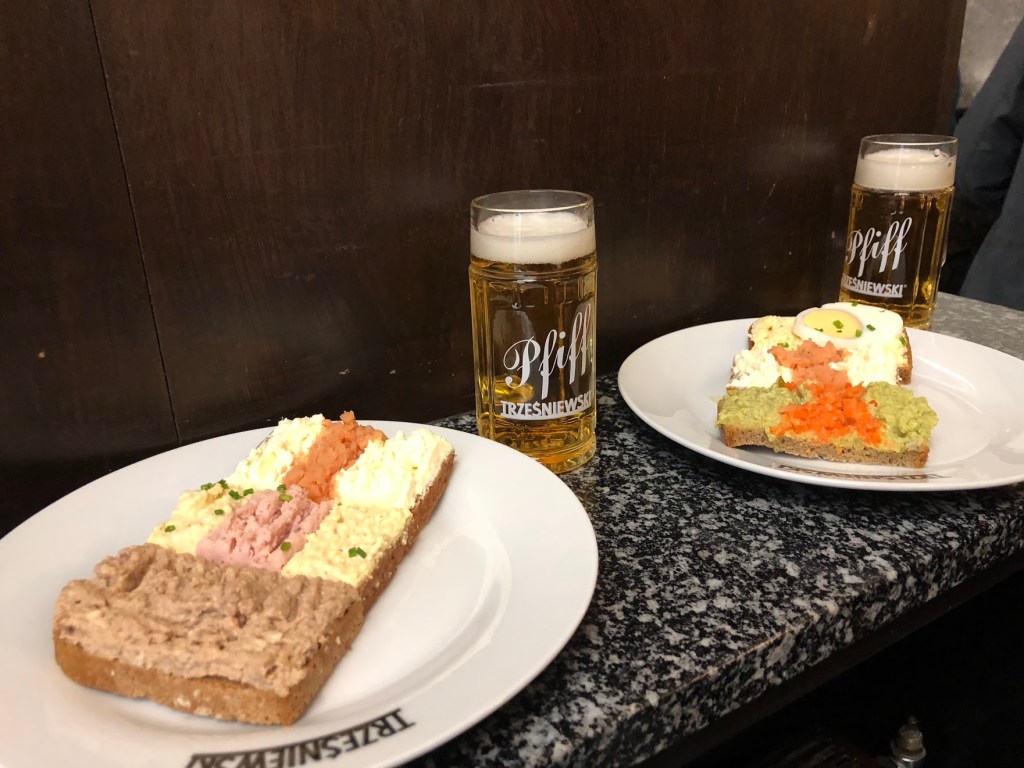
At the recommendation of Rick Steves, we headed to Trzésniewski, famous for its open-faced finger sandwiches. It lived up to the hype! With each one being just a couple of bites, and only 1€, we were able to try plenty of flavors. I’d recommend getting at least one that sounds a little wild – you may love it! And don’t forget to order a pfiff: a pfiff of beer is 0.2L or, about 6oz. Just enough to wash down your lunch! (But of course you can always get more! The beer is light and refreshing!)
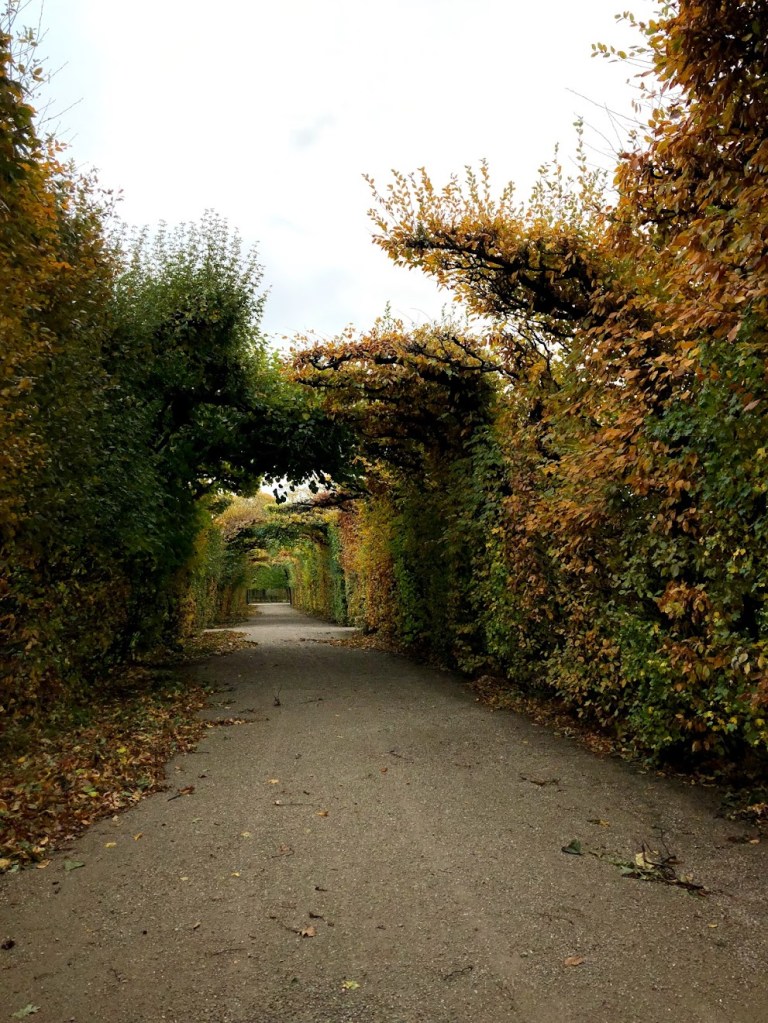
On Day 3, we headed out to Schonbrunn Palace, but it was a beautiful day, so we didn’t pay for a tour inside. Instead, we explore the grounds, which are expansive – and free! We wandered for about 2 hours, but could have spent a whole day out here. How they manipulated the vines to create a canopy… it was wild. It was an autumn wonderland.
On on fourth full day, we picked up the Vienna city bikes again and explored the Danube trail. We biked only to the edge of the city and back, but for those who want a bigger biking experience you can go all the way to Germany, or to Bratislava, and onward! In fact, we had initially planned on doing a day-trip to Bratislava, but we loved Vienna so much, we couldn’t justify using one of our four days for a day-trip.
Resources:
Many of the places we went were recommendation of Rick Steves, particularly restaurants we went to. His stuff is a great starting point, and we use it to map out recommendations that are close in proximity to maximize our time.
Vienna Lez-Travel rating:
Vienna was a delight, and a place my wife and I always felt safe. Pride flags flew in many places, and we were far from alone, both in the touristy areas and otherwise.
On the morning of our first full day in Prague, we shake off our jet lag and hustle by foot to the city center to meet up with our tour guide. Sandeman’s New Europe tours take place in many cities across Europe and are completely free. The tour lasts three hours and, in my experience, the tour guides are friendly, knowledgeable, and engaging.
We missed the start of the tour, but after running up to another guide, she was able to point us in the right direction for us to catch up. The tour took us through major landmarks of the Old City: the Astronomical Clock and the Old Towne Square; Church of Our Lady Before Tyn; view of Prague Castle; the old Jewish Quarter and Jewish Cemetery and more. Prague has a fascinating history, the the guide covers the Bohemian history, Austro-Hungarian Empire, Nazi occupation and WWII, the Velvet Revolution and fall of communism and Soviet influence. The tour was incredibly interesting, and a great introduction to both the history of Prague and beautiful sites around the City. A great day one activity!
Petřín Gardens
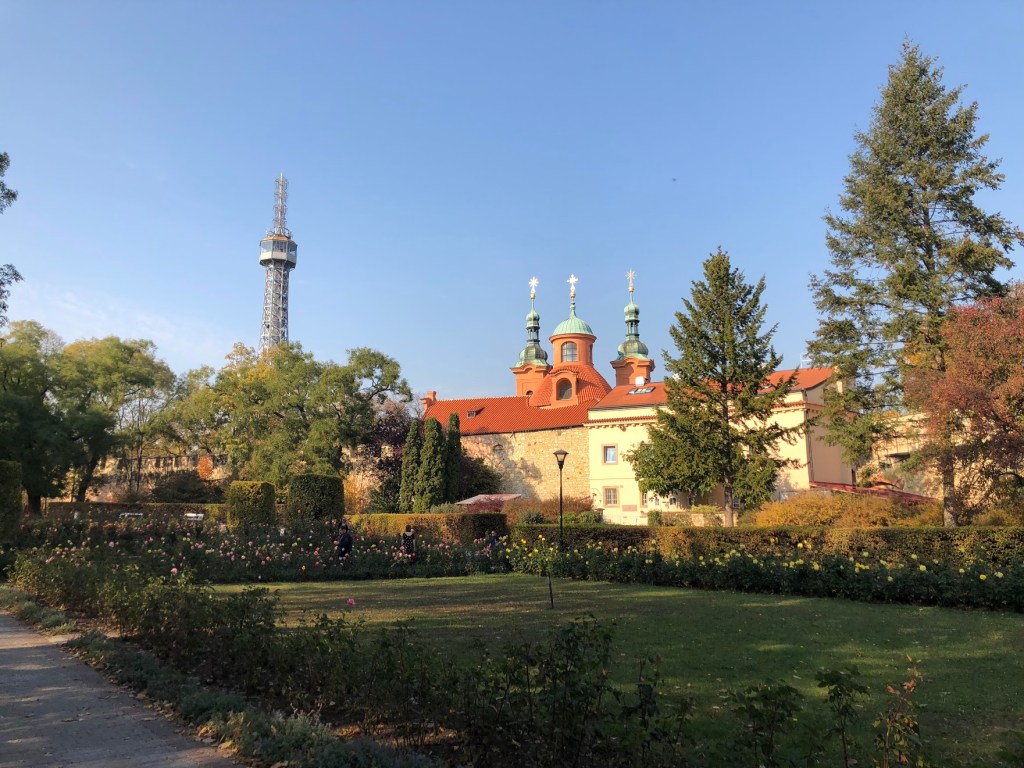
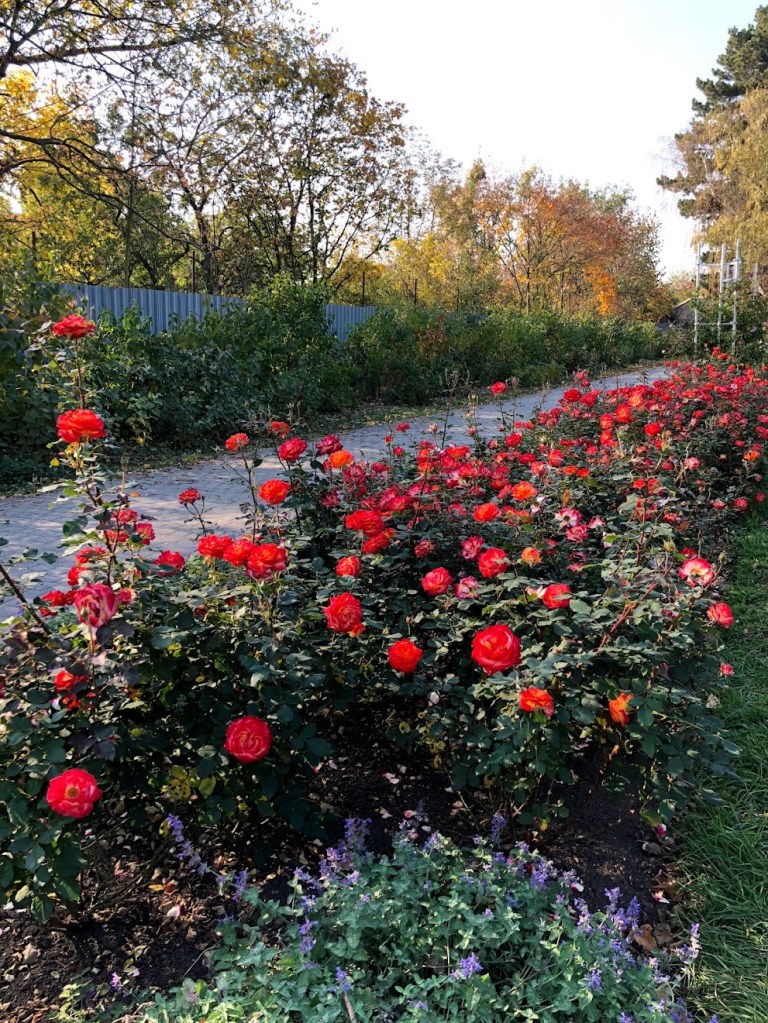
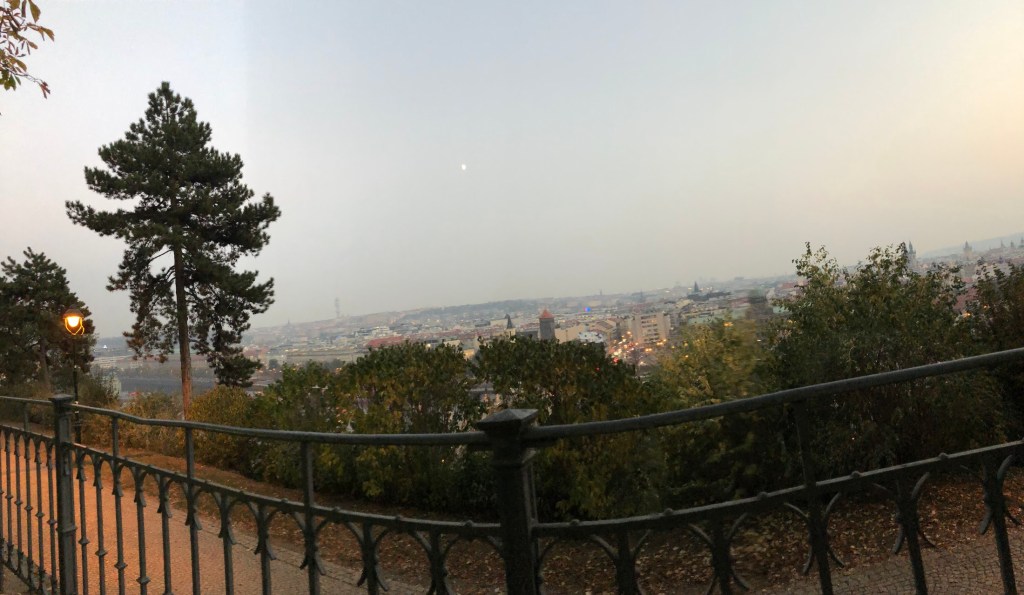
The area of Petrin Hill is basically a massive park full of gardens. You’ve got the Seminary Garden, the Rose Garden, Kinksy Garden, and more. An outdoorsy nature-lover could spend a whole day wandering here (and we about did). To top it off, there is the Strahov Monastery and BREWERY. Beautiful park, and I also get to drink delicious beer outside? Am I in Heaven?
After enjoying your beer, you can also walk around the grounds and inside of Strahov Monastery, which is also pretty incredible. You’ll have to snag one of the handouts to read about the artwork and displays in English, as the signs in side are in Czech.
In addition to enjoying the nature throughout these many gardens, you’ll also be heading up a steep hillside, so don’t forget to look around to get the occasional stunning view of the whole city (and wear comfy shoes).
I couldn’t choose just one picture of this area, so… here are several.
Speaking of the beautiful outdoors and beer, this brings me to Letna Park and the beer garden. Overlooking the river and the city, this outdoor beer garden is lively with tourists and locals alike. The whole park is worth enjoying, too; you’ll see other tourists but mostly locals with their dogs.
View from Letenský Beer Garden
Prague Castle
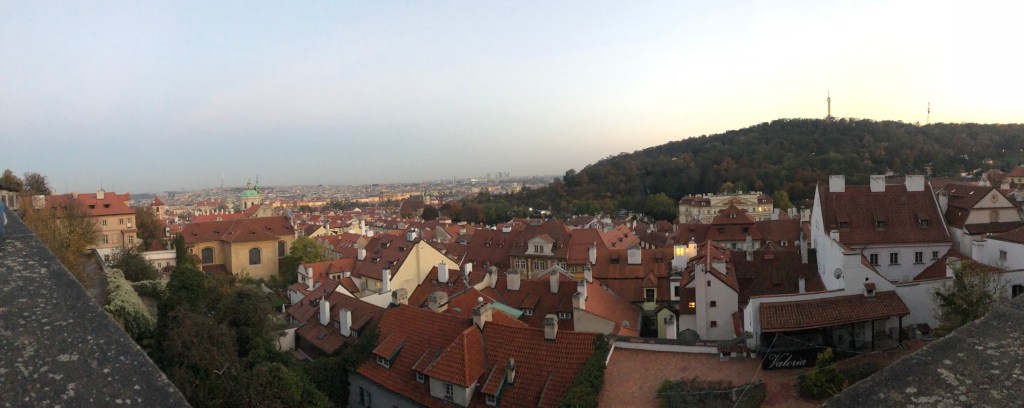
In the evenings, admission into the Prague Castle grounds is discounted, and definitely the way to go. For my wife and I though, we spent most of our time exploring the Royal Gardens. There are tram routes, but if you want to walk to the castle, prepare to get a good workout and enjoy some spectacular views! Here is one from the walk up to the castle.
View of the City from the walk up to Prague Castle
Better than Prague Castle is Vyšehrad, Prague’s “other” castle.
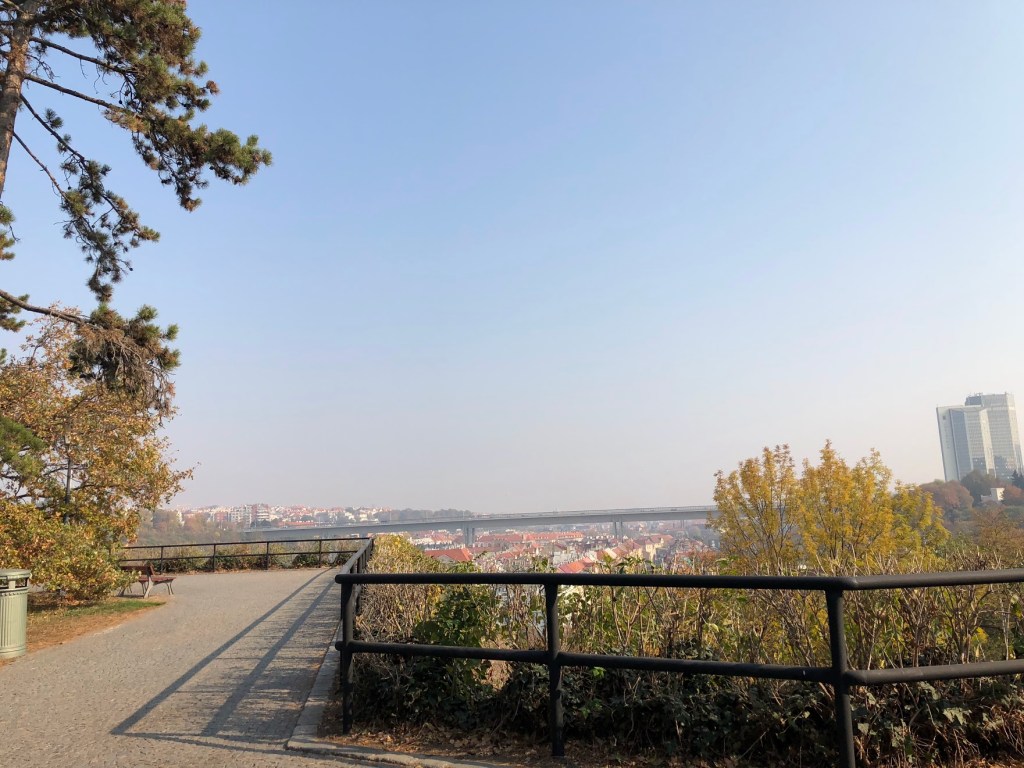
Vyšehrad has large grounds that are lovely to explore, especially in the fall. If you luck out with good weather like we did, you may spent all day in the area! From the top of the fortress wall, we enjoyed breathtaking views of the city, and it is totally free to explore the grounds.
We did pay a small fee to explore the hidden passageways and underground corridors, complete with a huge underground hall with monuments (how did they get those in there?!) – I believe it was about $3 per person, and the tour lasted around 45 minutes. Pretty cool to see, as this fortress dates back to the 10th century.
View from Vyšehrad
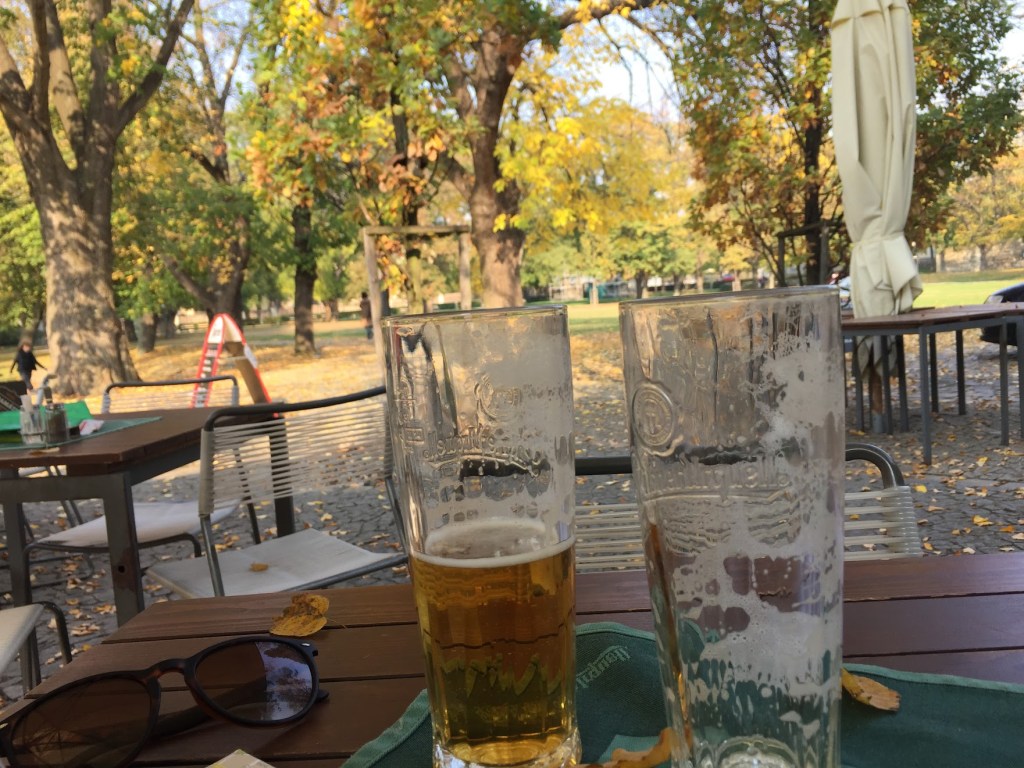
a little beer break at a café on the Vyšehrad grounds
The Food
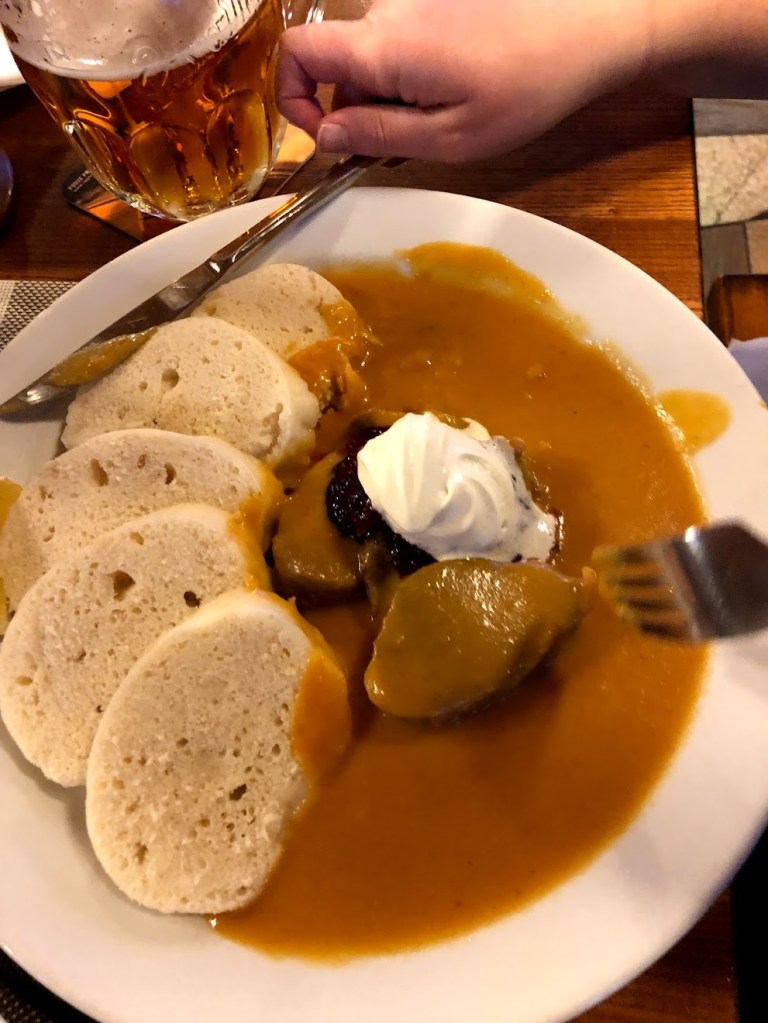
One of Prague’s signature dishes, Svíčková was the most incredible meal… one which I probably had, in some version, nearly each day. The vegetable cream sauce was always a little different, and the quality of the beef and bread dumplings (knedlíky) varied slightly, but from the large, crowded restaurants to the small, dark pubs- it was always damn delicious. The creamy vegetable sauce was always the best part, and as I’m writing this I’m drooling and determined to find some in the States as soon as possible.
Prague Lez-Travel Rating:
As I wrote in “Color of Prague”: Two rainbows. Though, our experience did vary based on location we were in. We did a beer crawl in the Vinohrady neighborhood, a younger, hip, and not too touristy area, which probably would have earned three rainbows. In general, we’ll go with two. The only funny looks we got were, I believe, from other tourists (of course from the guy in the Bama hoodie), but we didn’t see much example of gay pride or gay culture.
I am a planner by nature, to a fault, even. But with our Europe trip immediately following our honeymoon, there was no time to plan in the midst of planning a DIY wedding.
But, it was good for me to break free of my organizer chains and experience the freedom of exploring by getting lost, or pausing to look at our adventure options over an espresso (or a pilsner).
So while winging it on our travels, we discovered a recommended restaurant for ‘authentic Viennese’ that was high-rated among tourists and locals alike. Like fools, though, was how we looked when we arrived.
Married two days’ prior, exhausted but high on life, we flew into this magical land of age-old architecture and colorful urban parks in the peak of autumn.
I had hoped to learn a bit of Czech before our travel, but really just mastered a few key German phrases and didn’t quite make it to Czech. For that I felt immensely guilty, dreading being one of those Americans who assumes everyone abroad speaks English.
But they did, for the most part, at least those in our generation. Folks our age learned English in school, but those a bit older learned Russian. (So, besides the time we tried to purchase antiseptic ointment, we got by just fine.)