
What better reason to travel to the South of France than the marriage of two good friends? We booked our travel into Paris, with the high speed train to the region of Provence. The wedding took place in a small town in the countryside of Provence.
The day of the wedding, we had some time to explore before returning to get ready for the festivities. We headed to Les-Baux-de-Provence, a small village in the Alpilles mountains, situated beneath the ruins of a large medieval fortress, Chateau des Baux. We paid to park at the bottom of the hill and began the trek up the mountain.
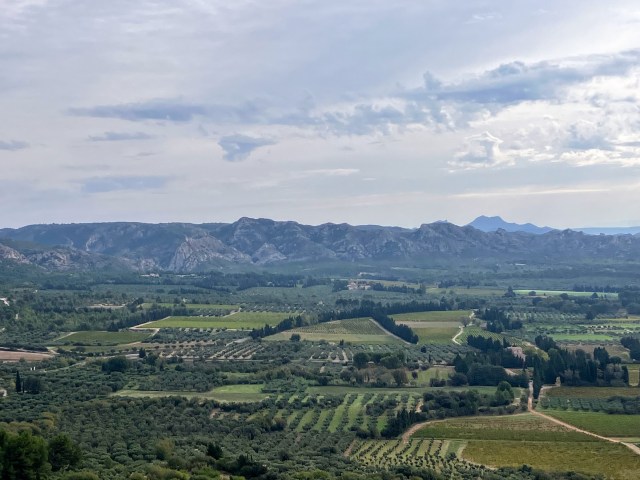
When we made it to the top, we stopped to catch our breath before roaming along the edge of the cliffs to enjoy the magnificent view. In fact, we enjoyed the view for too long that we had to abandon our plans to pay to enter and explore the chateau, and instead began our trek back down the hill to head out.
Our next task was to drive back down the winding roads to St-Remy-de-Provence. Wednesday is market day in St. Remy, a massive collection of vendors that stretches through a significant area of the town. The bride had requested we purchase some lunch snacks for her – and did the same for ourselves. Fortunately, our friend was with us who spoke conversational French (my wife and I – far from it) and helped us purchase a diverse selection of cheese, meats, and bread.
At a cost of only 40€ (also about $40 at the time), we purchased enough cheese and meat to feed the entire bridal party and ourselves (four of us, about 10-12 people overall). And the quality – far from anything I have enjoyed in the States.
Despite the notion that the French hate Americans (honestly, due to my interaction with American tourists, I don’t blame them), that was not our experience in the southern countryside. The vendors were incredibly friendly to us, and were thrilled that one of our party spoke French. The vendors would correct small errors with a smile, and thank us. They even let us sample every cheese before we made the purchase! And I mean – decent hunks of sample cheese, and one for each of us.
Following the wedding festivities, my wife and I and our two friends journeyed on to Cassis, along the coast in the southern part of the region. My wife and I had rented a car, as Cassis and the town of the wedding were not easily accessible by train (due to the mountains, the train station in Cassis is 2 miles from the town).
[*A note on driving in France, as we made a couple of mistakes: 1) the speed limits aren’t suggestions like in the States. If you go even 2 km/hr over the speed limit, you could get a ticket. And you won’t get pulled over; there are speed violation cameras that will automatically send a bill to you – a whopping 135€ – if you aren’t careful! and 2) it’s illegal to turn right on red. Did we turn right at a red light? Yes. Did we get pulled over immediately? Yes. We were pulled out of the train station/rental car parking lot… fortunately, the police officer only shamed us a bit for not knowing the rules (fair) and did not give us a ticket.]
Wanting to check out La Route de Crêtes, a remarkable 30-minute drive along the seaside cliffs linked Cassis to La Ciotat, my wife and I drove first to La Ciotat, and explored a botanical garden, Parc du Mugel. A reasonably priced pay-lot is nearby for parking, then a 10-minute walk down a steep hill and past a beach will bring you to the park entrance.
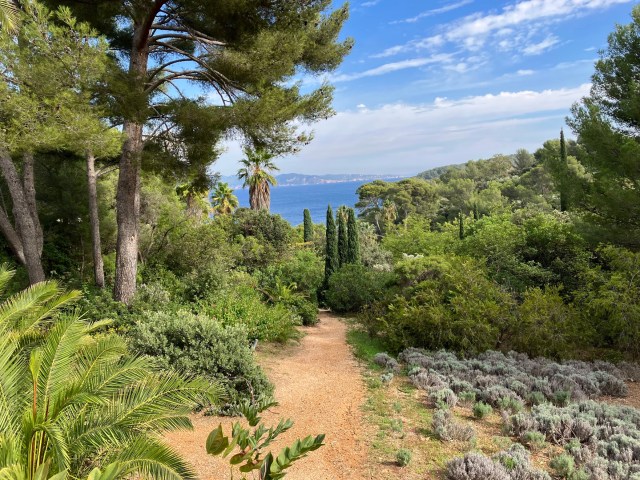
The park was beautiful, and entry is free. It had lovely views of bay, and vegetation I did not expect to see in France (bamboo!? Palm trees!?). At the top of the hill, you’ll also get a beautiful view of the Calanques.
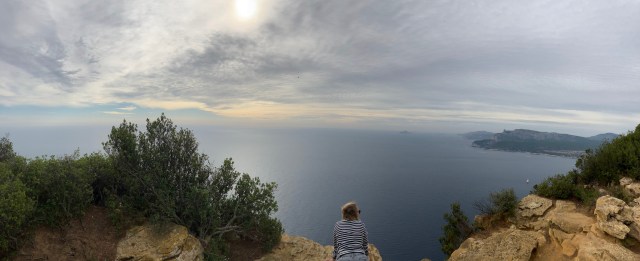
Once we got our fill of the park (hardly… I could have wandered there all day), we headed back to the car to start La Route de Crêtes. It definitely lived up to expectations. Though a somewhat scary drive at times (a VERY narrow, winding road), the views were breathtaking, and there were plenty of places to pull over and take in the views from outside the car. This one was our favorite lookout spot.
Once we arrived in Cassis, we found our hotel with some effort. An amazing thing about these towns in France is that they close off smaller streets and alleys during market days or dinner time, so that restaurants can use those areas for outdoor seating. But – the closed roads did make it tricky to get to our hotel! We ended up parking up the hill and dragging out luggage to our hotel, just off the city center. We stayed at a new Best Western; the rooms were very small and simple, but the price was reasonable and location was perfect.
We met our friends at a Rick Steves’ recommendation: Divino, a small and reasonably priced wine bar. The bartender was very friendly, and handed us some free charcuterie and olives to enjoy with our wine. He had three house selections (one white, rose, and red, all local) already selected and open, 7€ each, so you could select something without too much pressure and need to struggle through a French menu.
The next morning, we once again enjoyed market day (Fridays in Cassis). Though not as expansive as St Remy, the market still had much to offer, and we purchased cheese and bread to enjoy on our Calanque hike.
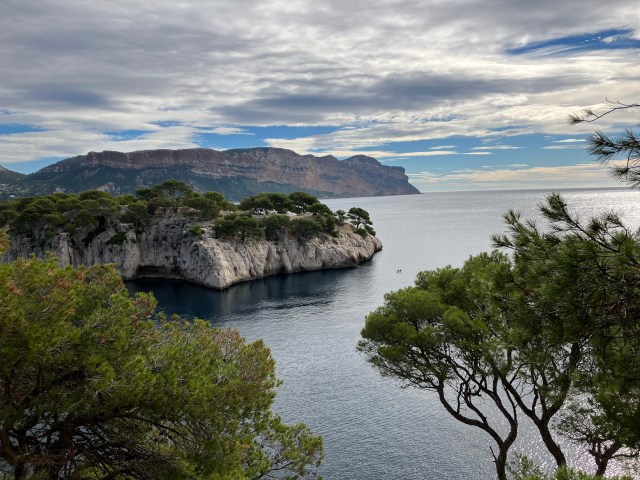
The Calanques: calanques are narrow valleys with sea inlets, surrounded by cliffs. Near Cassis, there are three notable Calanques: Port-Miou, Port-Pin, and d’En-Vau.
Port-Miou is a thirty minute walk from the Cassis city center, and it is a climb. You walk up from the port and through the wealthier part of town, so don’t forget to turn around and enjoy the view as you go (you may need to catch your breath anyway!). At the edge of town, you hike down a bit to reach Port-Miou.
A large sign for hikers show the other paths to the next two calanques. One route is steep and rocky, the other travels around – longer, but more gradual and more accessible. Even in the off-season (mid-October), the trail was quite crowded, so if you go in summer, start early!
We made it to Calanque Port-Pin in another twenty minutes from Port-Miou. The views were spectacular, and the small peddle beach beautiful. We got a later start than intended, and knowing it was another hour to Calanque d’En-Vau (each way), we bailed on seeing what is said to be the most beautiful of the three (next time!), and headed back. Exhausted from the hike and heat, we were thrilled to discover an offer from our hotel: since it was new, they offered each guest a free 1-hr private use of their spa. Fully recovered, we met our friends at a wine bar, La Maison de Jo et Gaby. We had intended to follow another Rick Steves recommendation, La Chai Cassidain, but sadly it no longer existed and had been replaced, in the same location. Nevertheless, it was delightful; we grabbed a small table in the alley and the bartender handed us a small menu with that day’s options for wine by the glass. The bartender understood English but spoke only French, taking time to help us with the pronunciations. He refused to pour my wife’s glass until she was able to pronounce the name of the wine correctly!
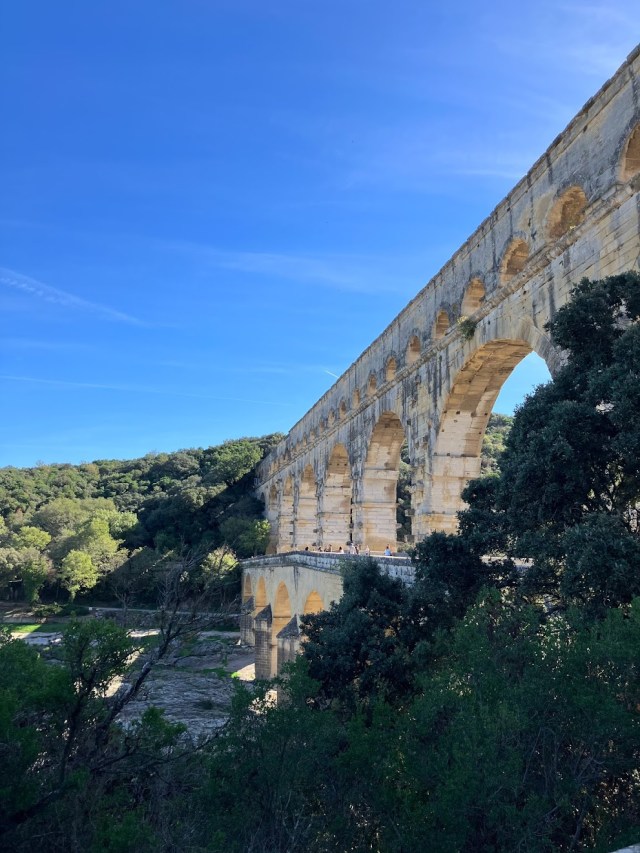
For our final destination, we headed to Nîmes, stopping first at Pont du Gard, a massive, 30-mile aqueduct designed by the Romans to provide fresh drinking water to Nîmes. In fact, it provided nine million gallons per day.
We had to return the rental car that afternoon and only had an hour available to explore Pont du Gard, but if we could do it again we’d allow 3-4. There are tours available and plenty of walking trails to get better views of the aqueduct. You can also rent kayaks to view the Roman sight from the Gardon River.
In Nîmes, we had a casual first night, picking up some pizza and heading to our airbnb to watch the Tennessee v. Alabama football game (Go Vols!). The next morning, we headed out to enjoy a full day of touring the city. Rick Steves mapped out a full day’s tour for Nîmes, complete with recommendations on where to eat.
The day started with the Roman Arena. We purchased the culture pass there, which provided us entry into all the roman monuments and the museum. The arena, much like the Colosseum in Rome, was pretty incredible to see firsthand. The climb to the top provided amazing views of the entire city as well. The audio-guide, though showcasing some over-enthusiastic voice-acting, was still quite informative.
From there, we walked across the street to the Roman World Museum. The museum was interesting, displaying thousands of Roman artifacts in the three-level, bright building. It’s worth a see if you have the time, but if you’re short on time, I’d recommend focusing on the Roman monuments.
The restaurant Rick Steves recommended was no more, so we hit up another place in the recommended square: Place du Marché. A note on eating in France – it takes a WHILE. Though the food is always incredible, meals are long, social events, even when you’re trying to simply grab a quick snack and coffee and then head out to sightsee (as we were hoping to do in Nîmes!). And if you’re hungry between 3-7pm, you’ll have a hard time finding food. Most restaurants serving dinner do not even open until 7:00 or 7:30pm.
From there, we continued the Rick Steves walking tour, heading to Maison Carrée. Dated back to AD4, the Maison Carrée is a stunning temple that’s stood the test of time, being consistently utilized for a variety of purposes since the Roman Empire. From there, we headed to the Fountain Garden, a lovely park (free entry) and the Temple of Diana, which is within. Finally, we walked over the Castellum, a small site on a residential street which is the end of the 30-mile aqueduct from Pont du Gard. And how about this: based on the water available, the lower holes serviced the wells of the neighborhoods. The higher holes – so, only when water was sufficiently available – serviced the homes of the wealthy. How’s that for equity!?
After our walking tour, we grabbed a pint (we had been drinking so much wine, as is customary, that we had really missed our beer!). We sat at a table outside, casually taking in our view: the massive, 2,000 year old arena. How the locals could get used to that is beyond me!
After our casual pint, we went around the corner to a bar with dozens of beer on tap, including many unique Belgians (which we looooove). At this bar, you could pour however much you want, so if you don’t want to be dragging yourself home after too much Begian tripel. And small pours means you get to try more!
To wrap up the day, we headed back to our airbnb to pack up and rest, needing to catch the 5am train back to the Paris airport in the morning.

Lez-Travel Rating for Cassis:
I felt a little out of place in Cassis, but it wasn’t because of my queerness. It was a huge tourist spot, and though winding down for the season, was still thriving with tourism. Perhaps it was more my socioeconomic status than my queerness, though the costs weren’t extreme, the town felt… uppity? I would go back for the nature and beauty that surrounds Cassis more than the town itself.
Lez-Travel Rating for Nîmes:
While we didn’t experience or see much LGBTQ culture (though in fairness, we didn’t seek it out), we wandered the city hand-in-hand without fear of harassment or hostile looks. Some establishments had the Pride flag hanging, including where we got our post-walk beers by the Arena.
Resources:
For our travel plans, we used primarily Rick Steves Provence & the French Riviera. We bought a used, older edition for cheap, (which I’m sure is why some of his recommendations had since ceased to exist). My favorite part about the Rick Steves book for this trip was him outlining a day-long walking tour in Nîmes. It saved us from planning out and estimating how much time each location would take, and we just followed his guidance and it was perfect!
 Lez Travel